Trisha Brown’s work is more than beautifully sensual, kinesthetically inquisitive, and artistically daring: it also stimulates my mind. I find myself puzzling out Brown’s strategies, asking questions, making discoveries. Two works, Foray Forêt and Raft Piece, performed in close succession at sites in Fairmount Park, offered such delights. I am grateful to the Fairmount Park Conservancy, the Philadelphia Museum of Art, and the Pew Center for Arts and Heritage, along with several other organizations that partnered to bring this transcendent afternoon to fruition. Thank you too to the weather gods: a more perfect day could scarcely have been ordered.
The audience wandered onto the lawn behind Mt. Pleasant Mansion (a spot new to me) and set chairs or blankets facing an empty stage framed by woods to watch Foray Forêt (1990). Entering along the grassy banks, a group of shimmery-clad dancers (costumes by Robert Rauschenberg) marked the stage-center line, then quickly dissolved into individual phrases of slicing leg gestures, winging arms, and tilting torsos. Creeping, hopping, slithering, and leaping across the space—woodland animals in their private rituals of exploration and survival?—some dancers melted off the stage, allowing smaller groupings to take over. Imperceptibly at first, the sound of a brass band reached my ears as the sun too approached, rising past the treeline, bathing the audience in bright heat. A butterfly flapped past, a few people rose (repeatedly) to move toward the retreating shade, and the band got closer, soon drenching us in their joyous notes. The music sounded loudly behind us and, turning, I smiled to see the players—wrap-around tuba, bugles, bandleader—circling past the house. Later, I heard them marching behind the stage, unseen through the trees.
Dancers continued moving onto and exiting the stage—sometimes attending to the musical rhythms, sometimes falling against one another in supported balances, falls, or lifts, sometimes disappearing from the scene, or standing quietly to one side. What to watch, what to hear? All was in motion: dancers, viewers, sun, insects, musicians, choreography: a dance in its immediate and years-old unfolding.
Exiting the scene after Foray concluded (while the sun continued its course and the butterflies their transits), we found the brass band joyously gathered in front of the mansion, playing what sounded like klezmer music for a dance I wished I, or someone there, could perform.
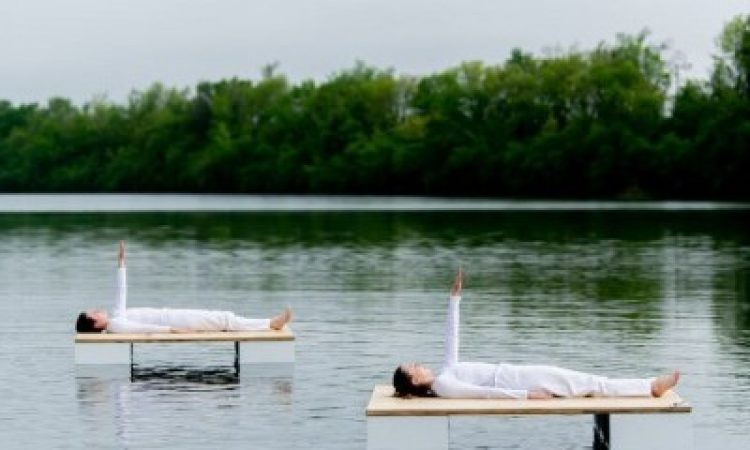
Instead, I drove the half mile toward the Discovery Center—for me, another previously undiscovered jewel of Fairmount’s vast expanse—to line up for admittance to Raft Piece (1974), performed by four dancers on the waters of the park’s reservoir. In my personal canon, this work is among the legends of postmodern dance, once performed as the rafts floated in Central Park past viewers on the paths’ benches. Here, I chose to stand on the pier, sharing the sensation of floating with the dancers, who lay supine on their rafts. What signal started their gestures—elbow bends, shoulder flexes, look right, fold knees, twist at hips? How, on their dispersed floating squares, do they manage such perfect unison in this version of Brown’s famous accumulations, spinning out a dance by means of repetitive-additive phrasing? I soon perceived the built-in moments for dancers to glance from raft to raft, to check on timing and, if needed, pause to catch the phrase: reach across, high leg, curve, roll, back attitude.
Three of the rafts drifted along the same trajectory toward the Discovery shore, while the one closest to me drifted against the pier, almost to my feet, temporarily separating one dancer from the other three. I observed her phrasing become her own, apart from the others: back arch, push palms, sweep left, fold right, head-on-hand. Then she caught sight of the others and rejoined their flow. Children’s voices from a nearby playground reached us as the rafts and dancers reached the ends of their journeys, delightfully.
In Motion, In Place: Trisha Brown Dance Company Foray Forêt and Raft Piece, Fairmount Park Conservancy, Sept. 28-29