With the holidays behind us, Christmas trees discarded, and Nutcracker advertisements gone from theater marquees, performers and audiences can ease into preparing for next year, looking forward to the possibility of yet another adaptation of The Nutcracker.
Despite its story—criticized by Deborah Jowitt for having a suspect title character, pre-pubescent thoughts of sex, and the suggestive act of an uncle giving his niece a hard wooden doll—the ever-popular Nutcracker has become widely adopted and heavily commercialized, performed by dance schools and companies to generate income.
The story of The Nutcracker has been adapted for productions performed by major companies, such as Mark Morris’s Hard Nut and—my favorite—Donald Byrd’s The Harlem Nutcracker. Byrd’s version is culturally familiar, socially relatable, and historically relevant. The production tells the story of a Harlem family whose matriarch Clara (different from the younger Clara played in most classical versions) relives her childhood, growing up during the Harlem Renaissance. Byrd offers audiences an alternative to the traditional Nutcracker by referencing moments in black history and building on themes of blackness, making the work especially accessible to people of color.
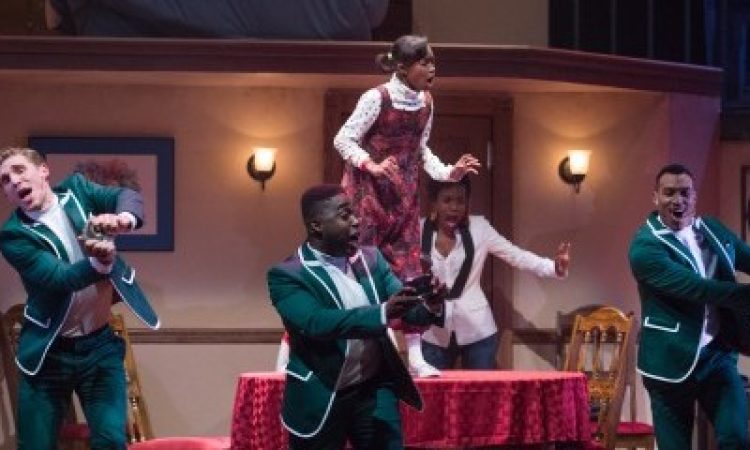
Another work building on the landscape of Christmas stories is The Classical Theater of Harlem’s (CTH) The First Noel, written by two-time Stella Award nominee and musical director for The Color Purple, Jason Michael Webb. A new musical (book, music, and lyrics) by Webb and Lelund Durond Thompson and the first musical for CTH, Noel is directed by Steve H. Broadnax III and explores universal themes of love and forgiveness. The story flashes back to 1985, where a young Noel (Nia Bonita Caesar) yearns for Christmas in a home where the holidays have been uncelebrated for years because her parents, Deloris (Soara-Joye Ross) and Henry (Nathaniel Stampley), use the time to commemorate the death of their first-born. When Noel’s grandmother Ethel (Tina Fabrique) pays a surprise visit, she introduces the young Noel to Santa, Christmas trees, and holiday gift shopping—all formerly inaccessible to the child. We learn that Ethel’s absence from her granddaughter’s funeral years earlier is the cause for her estrangement from Deloris. Henry works vehemently to reunite his wife and mother-in-law. In a climactic scene with Deloris, he opens her eyes to the discontent she breeds by holding onto the past.
Set on the soundstage of the world-famous Apollo Theater, the set by designer Daniel Robinson is a two-tiered house. The focal point is the dining room table, a symbolic reminder of the gathering place for some black families to talk, laugh, eat, and even to passionately disagree. The set extends into the audience, allowing the entire room to serve as the performance space, as the work’s characters tactically use the many entrances and exits of the peculiarly shaped stage.
Andrew Lederman (musical director) and Jason Michael Webb (orchestration) have created a mélange of jazz, gospel, pop, and re-imagined holiday songs to serve as Harlem’s answer to the recurrent classic. No part of the performance space is left unfilled as the voices of the 18-member cast soar symphonically. The music resonated with me long after I left the theatre.
The work’s choreography, by Brian Harlan Brooks assisted by Torya Beard, fuses modern and jazz movement with pedestrian sensibilities. The movement supports the story with familiar references: celebratory hand claps in the choir sections, staccato body pulses that simulate a jerky train ride, and the two-step footwork and unison body sway reminiscent of the Motown groups of the ’60’s.
With no party scene, dancing snowflakes, or land of the sweets, The First Noel unequivocally illuminates the interplay between family, friends, and faith, providing an alternative narrative to the fantasy and fairytale of other Christmas stories.
Where Christmas storytelling on stage was once synonymous only with the traditional Nutcracker, recent productions are moving into the realm of essential holiday entertainment. The First Noel serves as proof that theater-goers continue to search for diversity, supporting the power of multiple perspectives through art.
Info: The First Noel, The Classical Theatre of Harlem, The Apollo Theater, December 13–31, 2015.