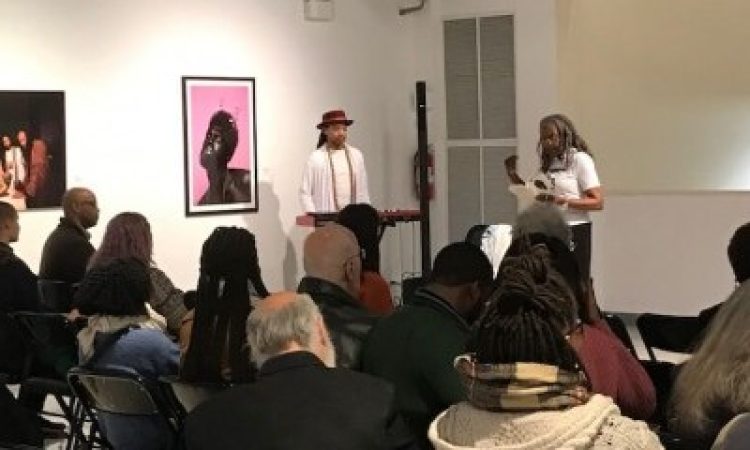
As I walk into the African American Museum in Philadelphia, I get absorbed in its current photographic exhibit, In Conversation: Visual Meditations on Black Masculinity. The subtle, playful tones of V. Shane Frederick’s jazz piano lure me to the top gallery, where Brenda Dixon Gottschild is presenting her performative lecture, Race is the Place is the Space.
In a 2016 interview, tD writer Lynn Matluck Brooks asked Dixon Gottschild, Professor Emerita of Dance at Temple University, where she would ‘shoot the arrow’ for change in the dance world. Her response, “I would burst the arrow into the tiniest, indecipherable shards possible at racism —the most glaring, tragic, intransigent issue in every sector of the American landscape,” manifests brilliantly in Race is the Place is the Space.
Layered in a long denim skirt over black pants, white shirt, a shawl and a head scarf, Dixon Gottschild storms in as Aunt Jemima, the racist stereotype portraying African American women as sweet and submissive caretakers. With its roots in Reconstruction-era minstrelsy, this deeply disturbing image, reincarnated into a pancake mix and syrup brand, remains on grocery store shelves and in our kitchens 130 years later. Dixon Gottschild’s Aunt Jemima energetically sweeps her way through the room, warmly greeting the mostly African American audience with jovial banter: ‘Hello, I haven’t seen you in a while….” She pulls three books from her basket: Citizen: An American Lyric (2014) by Claudia Rankine, Dixon Gottschild’s own The Black Dancing Body (2005), and Americanah (2013) by Chimamanda Ngozi Adichie. Varied in literary form, the critically-acclaimed texts were all written by black female writers.
She reads primarily from Rankine’s masterpiece. Described as a combination of poetry and criticism, Citizen sharply points to the ubiquity of racism in the U.S. today, from daily encounters to media representations. In her embodied reading, Dixon Gottschild merges voice, gesture, and movement with Frederick’s keyboard accompaniment to unlock the book’s penetrating contents and to highlight its poetic qualities. She walks, turns, and undulates her hips in a few simple dance steps, interacting with the musician and her audience. She plays with rhythm and tempo, providing emphasis or creating the punch line. Much as in rap music, she deconstructs words, making them sound like different ones. The deeply embarrassed ‘apology’ of the psychotherapist who has just racially profiled and verbally assaulted her new client—“I’m so sorry, so so sorry”—becomes, “I’m so sorry, so so sore-ey.”
That it is Aunt Jemima who reads Rankine’s portrayal of racialized others—or bodies out of place—highlights the complexity of the powerful, multi-layered performance.
As she continues reading, Dixon Gottschild begins undressing: first her shawl and her belt come off, a couple of moments later her skirt, until she peels off the remaining pieces of her Aunt Jemima costume. “It’s time to remove the last vestiges of Aunt Jemima. It’s time to remove all the stereotypes and the roles it is so easy to play.” Now she sports a white Philadanco T-shirt with a picture of a young black ballerina under the inscription “The Future.” In this moment, fully emancipating her body from the character, Dixon Gottschild transforms the stereotype associated with passivity and submission and uses it to perform an artistic call for black liberation.
A discussion follows the reading, where Dixon Gottschild prompts the audience to speak about key images or moments that stood out for us. Many express their appreciation of the performance and share the way they saw themselves reflected in the readings. They talk about being ‘invisible’ or ‘too visible,’ about anger, frustration, letting go, and empowerment. Dixon Gottschild concludes the evening by inviting each of us to hold the hand of another person, sensing their presence. We spontaneously form one huge circle of empathy and solidarity. I wish this was not a one-time event, but a repeated repertoire that could reach audiences across this country.
Race is the Place is the Space, African American Museum in Philadelphia, Nov. 17.