In a fourth-floor theater at Christ Church Neighborhood House, Germaine Ingram enters the stage carrying a box. She is dressed in yellow. As the audience continues to trickle in, Jungwoong Kim crawls in, a bundle of reeds (long, flat, wide raffia-like) strapped to his back. He moves as in slow motion, his hands cupped, sides of his palms touching the floor as he crawls forward. His forward momentum continues as he begins to rise from the floor, balancing with his hands touching the ground on one toe, the other leg bent, pivoting.
Kim pulls the sticks over his shoulder and cradles them in his arms before letting them roll down his arms. He lifts them in his hands and slams them into the floor, up and down, until they fall to the floor and a small section of reeds remains upright. Kim unties the fabric from the bundle; it is bright red. He whips it around himself faster and faster, evoking the ambiance of a matador.
Kim and Ingram discuss the idea of sound throughout the piece. What does sound evoke for you? What emotions and memory does it hold? Tapping into sound as a medium, they utilize tape players to play back different sound memories for one another.
Ingram plays “Every Time We Say Goodbye” on a tape player; she places a long plank balanced on a pillow and stack of books. She moves rhythmically backwards, following the beat as she slides a foot back flat along the floor and then pops her heel. Ingram muses aloud about the influence of John Coltrane and asks Kim to share a sound memory. Kim responds by imitating a train – he audibly makes the sounds of a train chugging along, and uses his body to depict a train as well, rushing forwards with arms outstretched, then circling his arms in reverse to back the train up.
In a poignant moment of connection, Kim and Ingram invite the audience to participate in the sharing of sound memories by recording their names and memories on a tape. The tape is broken; Kim seeks an alternative and then accepts tape from two different audience members to attempt to fix it. Is it staged? Is it authentic? We laugh regardless. After the audience records, the tape is played back, as the performers allow it to become their soundtrack.
While Ingram (a Black woman raised in Philadelphia) and Kim (a Korean-American man) hold different histories and sounds in their bodies, as all the memory sounds play over one another, they discover that sound is a medium that connects them.
within/without, Christ Church Neighborhood House, Fringe Festival 2024, September 1-22, 2024.
Home Page Description: Movement Research at the Judson Church. In the foreground, Jungwoong Kim kneels. They are sitting back on their heels with their palms resting on their thighs. They wear black pants and a red sleeveless top. In the background of the church, another dancer, out of focus, walks behind the kneeling dancer. They wear a purple jacket. Neither dancer’s face is turned towards the camera; they both look away in opposite directions.
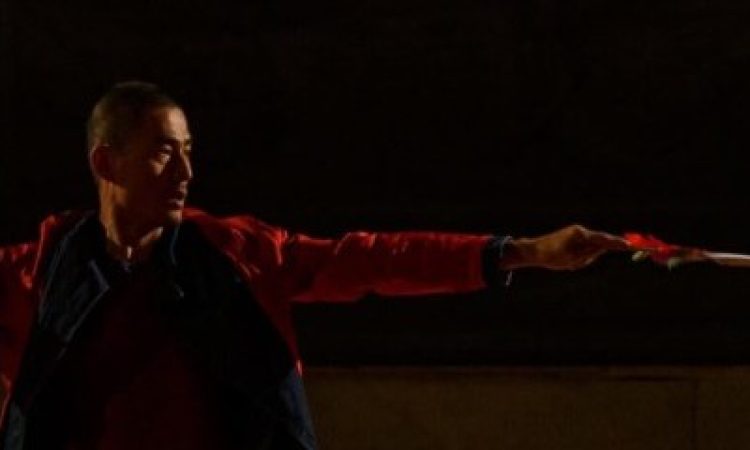
Article Description: An artist stretches their arms side to side with their body positioned towards the camera. They are looking in the direction of one extended arm and appear to be holding a wand or blade in their hand.