Upon entering, I am offered a laminated card, covered in stars. It lets me know that I will be called on to assist the dancers with my own body during the piece. I am led to the stage and stand where two pieces of wood meet at a right angle. Jazzy, freeform-sounding trumpets blare around me as the cast of Falling Up – six dancers wearing matching gray coveralls – slo-mo run on the diagonal towards those of us onstage.
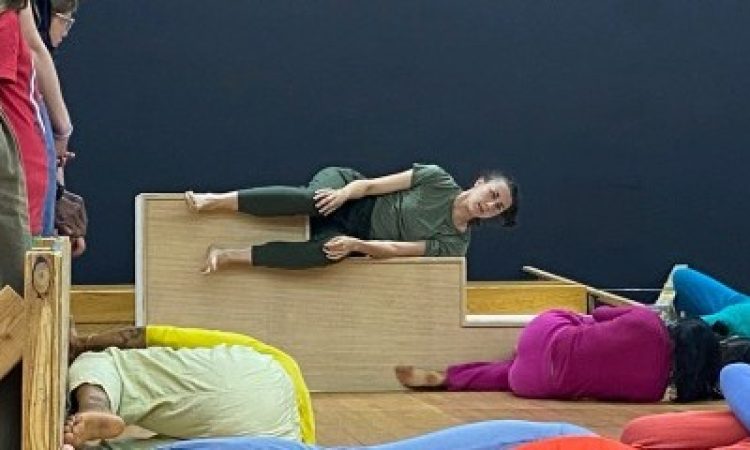
Their muscles exert themselves in both intensity and as close to stillness as possible. The audience members watch as dancers descend to the floor and curl up in the tight square made by the two wooden walls and stage edges. Rolling and twisting, pulling and pushing, they rotate in a circle, using the walls and each other to tumble about the confined space, all the while never losing their suspension of slowness. I look down at the dancers as they crawl and bend their way across the floor, and I am overtaken with a sense of wonder, looking forward to the world they’re creating.
Dancers Amalia Colón-Nova, Chloe Marie, Harlee Trautman, Katherine Kiefer Stark, Marcie Mamura, and Meredith Stapleton collectively explore various Judson-style vignettes of exaggerated actions. The movement shares a theme, stated plainly in their program: what if we “turn[ed] the world anew, again and again and again”? Interspersed by moments of stillness where video clips, directed and edited by Colón-Nova, play in the dark room, the dancers playfully explore moments of tenderness and joy. In one section, they push the wooden scenery to form an imaginary swimming pool. Dancers take turns cannonballing in glee or frantically doggy paddle, all overseen by Stapleton twirling a whistle à la the cool lifeguard. In another scene, the dancers use the floor to extend a rope ladder from the stage to the sides of the theater space, then contort in drastic imitations of terror and bravery.
When the dancers finally stand, leaving the comfort of the floor’s abilities as a duet partner, the six form pairs and a trio, moving luxuriously as though through the sheerest water imaginable, arms carving around heads or legs suspended in the air. They form clumps, arms around one another in gestures of solidarity and love.
The sheer happiness in the eyes of the dancers is what stands out the most about Falling Up. They treat each other thoughtfully and gently, with holds and hugs, laughing and enjoying the simple presence of one another, of moving and exploring together. Falling Up appears as a look into the process of creating, wondering, questioning where true joy can be found.
Falling Up, The Naked Stark, Icebox Project Space, Philly Fringe Festival, Sept. 2-14.