Gentle thunder threatened as the dancers took their places, and Steve Believe began to recite Fruit of Her Lips, the titular poem written by choreographer Evalina Carbonell. Believe moved around the strip of marley laid in front of a converted garage as we watched from a driveway now transformed into an outdoor performance hall. As the music began, Sophie Malin shifted outside to the marley, leaving Weiwei Ma and Carbonell behind in the garage. A few raindrops fell, but Malin was captivating as she stepped strongly into an arabesque and then melted; I couldn’t look away long enough to check the sky.
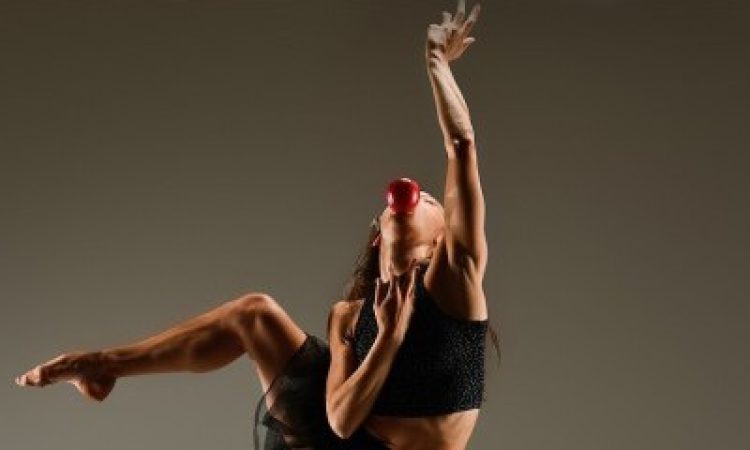
Carbonell structures Fruit of Her Lips as a series of 13 interconnected short dances. The music evokes 1920s Paris: light, jazzy, joyful. Bowler hats and an apple held in Carbonell’s mouth while dancing add a touch of surrealism, as does the opportunity for dancers to partner objects (a table, a chair) instead of one another. Poetry flows in and out, adding nuance and context to the dances it accompanies.
Of the 13 dances, two particularly drew me in. In Sprig, Carbonell’s six-year-old daughter Lina dances with Believe, leaping across the stage and mirroring his movement, bringing forth joyfulness and breathing fresh air into an art form that can often be formal and controlled, such as in later pieces where the dancers incorporated audible breath with their movements. Sprig, however, was unrestrained. I was delighted to experience it again when the show re-began after we took refuge from the rain inside the garage-turned-studio. As it poured, Lina’s joy reenergized both the audience and dancers.
In The Plum Trees, Malin lies on her back on the table as the other dancers peel small mandarin oranges and cover her in the peel and pieces of fruit. Poet Mary Oliver’s words recited, “the only way/ to tempt happiness into your mind is by taking it/ into the body first,” provide the perfect background. The slowness and the poem fit with the intimacy of being up close and personal with the performers in a rain-adjusted place.
A storm interrupting a show? Yes. And a small child with curls in a green dress bouncing joyously. The sensuality of covering a person in orange peels. The breeze as Believe breakdanced, spinning on his back, his leg passing just inches away. Yes, the show must go on, and sometimes, the experience is more intimately memorable because of it.
Fruit of Her Lips, Eva “Wally” Carbonell, Mt. Airy Waves, Philly Fringe Festival, September 7-9.