Watching Hora, choreographed by Ohad Naharin, I am struck by the absolute prowess of the dancers. Each kick, split, and back bend goes further than expected, and I am captivated by their full-bodied commitment to the elements of the dance. It is a joy to watch Batsheva Dance Company move. As drawn as I am to the dancers, and intrigued by the world they inhabit, there is a separation between us, like I’m watching a pod of organisms in an aquarium; a glimpse into a beautiful internal world, forever separated by glass. I spend most of my time seeking to make sense of the relationships onstage that are at times dominated by a puzzling sexual energy.
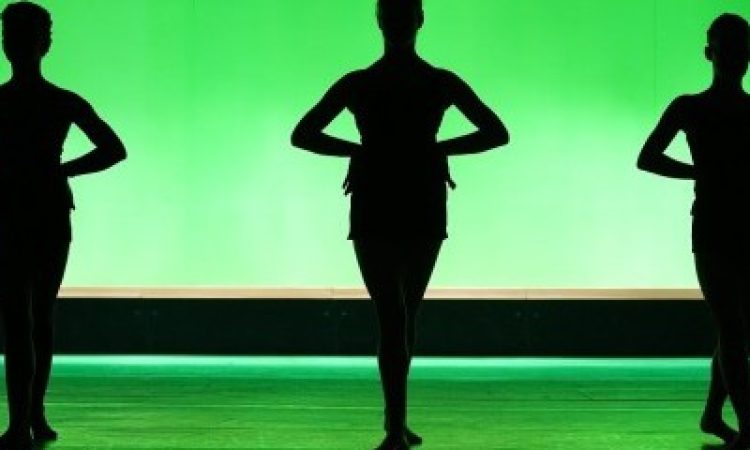
The first image of Hora is a long line of dancers standing in front of a bench that runs the entire width of the stage. They wear black, arms and legs bare, and are surrounded on three sides by green screens. Their bare skin and black costumes pop against the green, almost as if they are emerging from the screen itself. The set and lighting design by Avi Yona Bueono remains constant throughout the work so that shifts in mood are dependent on the dancers’ movements and the musical accompaniment. The music is a driving force for Hora, arranged and performed by electronic music pioneer Isao Tomita. Tomita samples well-known compositions like the Star Wars theme, 2001: A Space Odyssey, and Prelude to the Afternoon of a Faun. The changes in music correlated with changes in who and how many dancers were in focus, but the music did not affect the dancers’ relationships nor move the piece in a clear narrative direction.
The performers group themselves differently as they move through their world—at times swarming together; at other times solos, duets, trios and other groupings emerge. One dancer would walk downstage and shake her hips side to side with gusto, and the rest of the dancers would remain unchanged. In another section, a dancer brings two hands near her heart, thumping rapidly against her chest. This gesture spreads throughout the group. It is inexplicable why some movements take hold of the group, and some do not.
The push and pull of the individual, remaining alone, joining, or being joined by others is repeated throughout Hora. A single dancer would gesture and the group would take it up, or the inverse, a unison group would push out a solo dancer. A sideways, low-crouched punch made for a striking gathering of bodies—the punching gesture recognizable, yet rendered askew and peculiar in this clumped organism. The accumulation of bodies mattered more than the gesture itself. This was the pod mentality.
The saturated colors, the dancers’ blank faces, and the sexuality of many of the movements reminded me of the Hulu series The Handmaid’s Tale. At one point, a male and female dancer stand facing each other, a cupped hand repeatedly stroking the space in front of their genitals, building in speed and intensity until achieving climax.
Towards the end of Hora, the men form a group and the women stand around them repeating a loud and guttural “HA!” This moment brought me closest to reflecting on the title of the work, “hora” meaning “circle dance.” This “Ha!” was not an utterance from laughter; rather the strong, staccato, deep from the belly sound signaled a rebuttal, or a sign of strength—or maybe it was pod-speech. I was surprised when the section resolved with a woman walking forward and mounting a man centerstage.
It occurred to me, leaving the theater, that there are aspects of Hora that now take on a different tone than when it premiered in 2009. The sexual gestures and energy of the piece landed on me as dominant and sometimes coercive. The dancers did not join one another as a community, but instead they were taken over or left out. When they sat along the wall watching each other, they were alone and powerless. Too often couplings or gestures took on sexual mimicry that was gratuitous and patriarchal. These feelings cut through the visually provocative set and lighting design, the stunning dancers, and an intriguing musical score, and mainly left me unsettled and puzzled.
Hora, Batsheva Dance Company, The Joyce Theater, Feb. 28 – March 12.