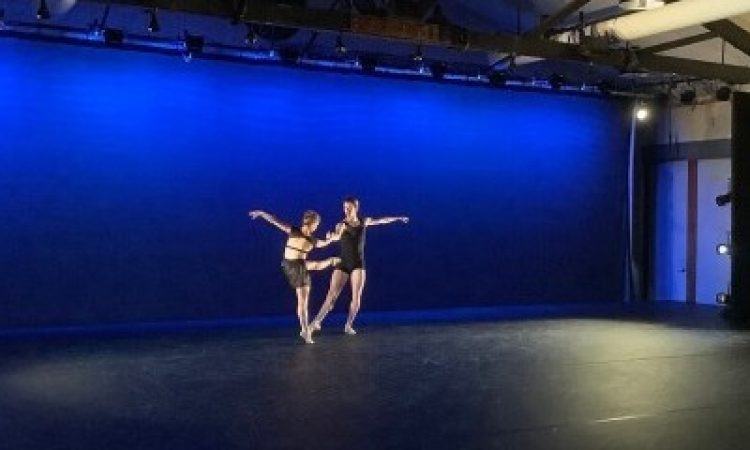
After a contemplative walk in stark silence, soloist Grace Kimble jolts into a sprint. Kimble invites audience members to step onto the Treadmill, as if preparing for the marathon performance of Bryan Koulman Dance Company’s summer showcase. Kimble, indulgent with time, sustains a forward walk, advancing downstage before breaking stride with an agile quarter turn to her left. She resumes her slow assessment in this new forward facing disposition. An abrupt switch, and Kimble runs–rigorous yet stationary. Gradually, she slows to a side-to-side, seesawing rhythm, shifting weight until balance crumbles.
Treadmill, a work from 2002, was the evening’s single work that was as thought-provoking as it was technically and aesthetically impressive. Austin Eyler rushes to break Kimble’s fall. He takes up her stationary sprint. She later returns the favor, and they continue to orient toward and away from each other, as if in indecisive longing and ambivalence. When they embrace, it’s a sudden and fleeting juncture before the duet returns to its distant synchrony. The dancers navigate an exhaustive cycle of care and contemplation, until endurance retires and a partnerless Kimble surrenders to gravity, collapsing on the floor as the stage turns dark.
The Koulman company re-emerged following a COVID-19 hiatus at the Performance Garage, featuring both new and previously performed works. Koulman set an arrangement of contemporary ballet phrasework performed by Lucia Erickson, Eyler, Kimble, Nayara Lopes, Gabriela Mesa Ochoa, and Pau Pujol. The ensemble enlivened the movement repertoire representative of Koulman’s self-titled company. The composers and musicians behind the show’s soundscape include Richard Green, Koulman, Christopher Rouse, Debussy, André Jolivet, Arthur Honegger, John “Billy” VerPlanck, Continuum Percussions Quartet, and Rodion Shchedrin. Treadmill and Tiger featured live accompaniment from Ismael Biaz on percussion, and Michael Moss on soprano saxophone.
The stylized ballet displayed poised technical skill, making shapes through both body alignment and staging in quartets, duets, and trio arrangements. Each piece featured the artist’s athleticism, precision and control–although partner work lacked chemistry between the dancers, in need of moments of expression, breathiness, and eye contact. Even in the more playful Tiger (2004, 2022), performers who mimicked rambunctious tiger cubs remained stoic in their expression and stage presence. Dancers accomplished diligent, energetic footwork, a series of fouettes, attitude jumps, grand battements, all the while weaving amongst each other, they take turns exchanging space to the meter of quick drum beats. But the absence of affect made the movement seem calculated and robotic. The delicate, upward emphasis contradicted the deeply rhythmic sound score–one which evokes downward, weighted, and grounded movement. The rumbling percussion had potential to evoke more enthusiasm and sincerity than what the dancers presented.
The Lonely Snake (2022), a more sensual composition, demonstrated Kimble’s skilled range of performance quality and technical ability. She wore a tan bodysuit with a long green fabric stitched onto it that slithered around the soloist’s leg and side-body, flattering the essence of the piece (costume by Melinda Pendleton). Kimble’s leisurely yet decisive and sly movement was punctuated by piercing gazes and darting gestures.
In Shchedrin (2020, 2022), the evening’s finale, the full ensemble took the stage in a show of their endurance and fastidious technical background. The gendered choreography, a staple of traditional ballet, revealed itself most potently in this piece, reiterating a display of power and submission often assigned to masculinity and femininity. Feminine dancers lay downstage, upward-facing with their legs extended wide in an inverted display of flexibility. Countering, masculine partners stood tall upstage in observation. The intention was unclear as the dance proceeded with various groupings and partnering. The ensemble presented momentous lifts while crafting neat lines and symmetrical formations. Despite that, the focus of the dancers seemed audience-oriented and ambivalent toward those with whom they shared the stage. Finger-snapping and hand-clapping, they began to kindle connection. This collaboration energized the closing act and offered a synchrony absent in prior works.
The Koulman company enmeshed classical and contemporary ballet aesthetic. The ensemble presented uniformly across costume, hairstyling, physique, and physicality. Their performance epitomized a traditional movement repertoire that reflected Koulman’s foundation in classical ballet. Gestural motifs, transient surrenders to fluidity, and rounding of the torso and hips were assets to the intricate choreography which exhibited the dancers’ technical expertise and added nuance to each dance.
Bryan Koulman Dance Company, Performance Garage, June 17-18.