“Gathering Space is a chapbook, a non-virtual place for sharing ideas in the COVID era. In the book, sixteen people from fields spanning visual art, performance, design, somatic practices, writing, and the sciences play around with, explode, and explore ideas related to (or a digression from) the words “gathering” and/or “space.” The violence, grief, beauty, reflection, and imagination of this last year find form,” from the Gathering Space site.
I was hesitant to respond to another work that digests the pandemic experience. While this reality has not quite lifted, there is certainly an impatience around it. I was pleasantly surprised by the quiet and sundry ways in which the essays, works, poems, and compositions in Gathering Space chose to deal with the topic.
Gathering Space is an interactive phenomenon reaching out into community. The creator, Aynsley Vandenbroucke, states: “Since the roles of “gathering” and “space” have inadvertently become so tied up in our lives – with what we can and can’t, should and shouldn’t do – I invited these contributors to play…”
The pages by Louis Bury are a collection of daily sentences that don’t relate at first but build up a narrative and a feeling of watchfulness. They describe places and layers of history, talking about the George Floyd protests as much as they talk about streets and abandoned portions of life. You catch glimpses of the way a person is watching the world shake. I found a similar energy in the essay by Cori Olinghouse. Both works describe and deal with places of disarray and neglect. Olinghouse is more focused on loss and how spaces contain our memories: “My whole life I’ve been obsessed with space…In one memory, my Mom held me on her hips with a short blue terry cloth robe and her hair brushed back off her neck…Later, in another house with a stucco exterior and weirdly shaped rooms, I saw a hand appear on the inaccessible window of my second floor bedroom…I thought a man lived in-between the walls.”
A handful of interactive works are included. A piece by devynn emory called feeding Nana asks readers to make a family recipe and share it on social media using the following tags: #feedingNana and #CindySessions. The pandemic took a lot of elders from us and this piece resonates with that loss. The action of sharing recipes intends to link us to the wisdom of our matriarchs and also to each other; breaking bread alone together. Another work by Aatish Bhatia, called Tangibles, gives instructions and a link to a website that interacts with and translates the viewer’s gestures through webcam into drawings. Of this work, they say “What if interacting with the web were less like reading a newspaper and more like dancing?”
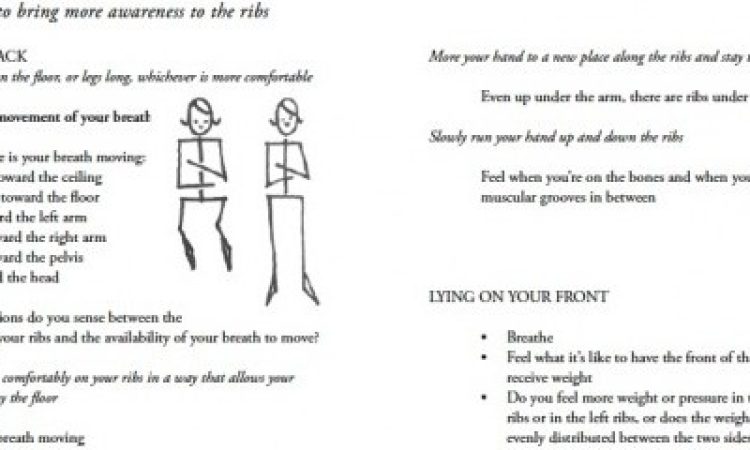
Rebecca Davis offers an instructional score for somatic breathwork entitled a breath practice to bring more awareness to the ribs. With drawings and prompts, it walks you through an exercise that connects you to the 3-dimensional reality of your lungs and their housing in the ribs. It could be read as an art piece or followed like instructions. This work asks for presence in your own body – certainly another interpretation of “space.”
There are also a few musical scores. The Nothing Etudes by Jeremy Toussaint-Baptiste look like regular musical notation but they don’t seem to be playable. Ultimately, they act as visual works; poetic drawings of loneliness and quietude.
All of the artistic responses inGathering Space play between finding, having, remembering, losing, and keeping – a web of experiences and thoughts on the prompt of accumulation and making room. It feels tender, like a still sore bruise that’s healing. The whole interactive experience of sharing feels like pain management for the exhaustion of this moment.
This is not a book, really. It’s an act. Thoughts, images, words, feelings, are pulled together, but the object created is not for sale. It was free for the taking at a number of book shops and galleries throughout New York City and beyond. The works contained in it are a treatise of the experience of self, other, society, and space during the pandemic. Beyond its content, I find Gathering Space important as an object. Perhaps the most exciting phenomenon is experiencing this bridge between artists of a larger community – a silent interaction meant to gather us towards each other and towards our own place.
Gathering Space, editor Aynsley Vandenbroucke, book design David McNamara, March 2021.