Beyond Moving (2019), directed by Vikram Dasgupta, is a film that follows Siphe November as an eight-year-old boy in his hometown in Zolani, South Africa to a student at Canada’s National Ballet School in Toronto. The film then fast forwards to Siphe’s final years in the school as a teenager, from 2014-2018. In form Beyond Moving is a documentary about becoming a ballet dancer, but embedded in the narrative are questions: what is success, who decides, who gets opportunities, and how do we relate to home when we have been gone for so long?
We first encounter Siphe at eight years old in Zolani, an impoverished township that juts up against lush vineyards in the Western Cape of South Africa. He is a natural entertainer – dancing in the street, making funny faces, and laughing a lot. Dance is embedded into the culture where Siphe lives, we are told by Fiona, Siphe’s first ballet teacher. However, the idea of dance as a career, is not. The film’s director, Dasgupta, does not address how Fiona comes to teach in Zolani, nor how students gain access into her program, but we see from footage that Siphe and his older brother are star ballet students. Later in the film, the brothers (now as young adults) reflect that their childhood ballet dance classes set them apart from their community. Both brothers ultimately leave Zolani, but the film only follows Siphe’s journey. A stranger visiting from Canada sees Siphe perform, arranges his audition for Canada’s National Ballet School, and sponsors him in Canada after his acceptance.
I appreciate that in a documentary about a dancer, we see a lot of Siphe in ballet class, rehearsing and performing. Dasgupta includes footage from Siphe’s audition tape and his improvisations are a lyrical music and movement pairing, with his body matching the soaring and emotive quality of the music. His spine arches and undulates and he embodies every gesture. Siphe’s ability to modulate his energy is beyond his years. The film does not linger on the family who sponsors Siphe in Canada. We see little of Siphe navigating his new life. There is footage of him driving to his sponsor’s home for the first time and I wish I knew what he was thinking and feeling.
I wanted this captivating and talented dancer to succeed and have opportunities, but I often thought about what was not being said as I watched Beyond Moving. The film captured the loss of home, family, and community that Siphe deals with when he returns to visit Zolani as a teenager. His former teacher Fiona expresses disappointment that he does not give back to his community, but I wanted to know more about how Siphe felt returning home. Siphe’s Canadian friend who joined him mirrored one way to witness Zolani: polite, respectful, and trying hard not to indulge in poverty porn. Should I celebrate Siphe’s triumphant return? How was he negotiating being home after years in the exclusive world of ballet? Not exploring these issues explicitly may be the director’s tactic. There were many shots where the film lingered on Siphe’s face, and I willed him to speak, but most often he did not. Since the film’s subjects did not directly confront the white savior storyline, I must process that on my own. Dasgupta does not offer me a clear choice for self-righteous indignation nor for celebration.
A powerful moment comes when another of Fiona’s students performs for Siphe. We hear his voiceover—he tells us that hard work and talent are not enough—stacked against him is a whole system of poverty and racism. His role in the film complicates Siphe’s fairytale by implicitly pointing us back to the role of a Western patron in his success.
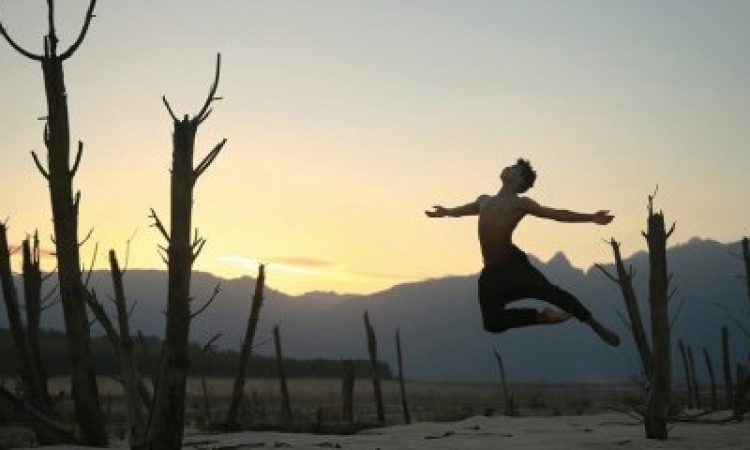
Siphe’s older brother is also a professional dancer and choreographer living in England. I would love to know more about his story and how they both came to be successful professional dancers. While Dasgupta does not follow this story, we do see the brothers together as young men. Siphe’s brother dances for him in the sand, with the mountains towering behind him. As he jumps into the air and spins, his feet kick up the sand, which then suspends into the air and cascades around his body. This was one of several moments in the film when Dasgupta captures the internal drive to dance that these two young men display.
At the end of the film, after Siphe graduates from ballet school, he visits his home and performs in his former studio. As he is onstage, some in the audience (his family and friends) wipe away tears. Then the show turns into a dance party as they join him onstage. As the group walks down the street, Siphe performs again with the crowd around him in a circle. Why this second dance, I wonder? I am less interested in Siphe and more curious about those in the crowd. What are they thinking and feeling, watching him perform for them? Many times, while watching Beyond Moving, I think about home – why we leave and how do we return? What does it mean to dance for a home?
Beyond Moving, Bryn Mawr Film Institute, digital screening, December 1.