Theatre Philadelphia and thINKingDANCE continue our partnership, begun in 2018, bringing coverage and new perspectives to Philadelphia’s vibrant theatre scene.
I was giddy when I sat down to see Eugene Ionesco’s 1950 “anti-play” The Bald Soprano, performed by The Idiopathic Ridiculopathy Consortium (IRC) as part of Theatre Philly Week. I was expecting an hour of anxious laughter and was nervously anticipating the final scene in which the disintegration of language and logic would reach its violent climax. Though I had never seen it performed, I was familiar with the text of this play and, at that moment, was hyperconscious of its relevance both to certain failures of communication I was personally experiencing and to current semantic crises in politics and civil society. Director Tina Brock’s remounted production, with its campy sensibility and clever staging, managed to conjure the right proportion of seriousness to levity for a moment of catharsis in this climate.
The performance commingled the play’s absurd reality with the “real” world in several ways. Spatially, the set (also by Brock) had no walls and instead was framed subtly by the plush but dated furniture that constituted the Smiths’ living room. A small bar near the entryway to the exhibition space at the Bethany Mission Gallery (in the center of which the play took place) further integrated these two realities by extending the set into the audience space, establishing a pathway utilized primarily by Mary the Maid (Tomas Dura) in the course of her serving duties. Brock’s enmeshing of these two environments escalated in unpredictable, choreographic ways as the action unfolded: the characters gesticulated to the artworks displayed on the gallery walls to illustrate their nonsensical comments and stories, and when Mrs. Smith comically exited the “stage” to answer the repeatedly ringing front doorbell, the door she opened was ours as well.
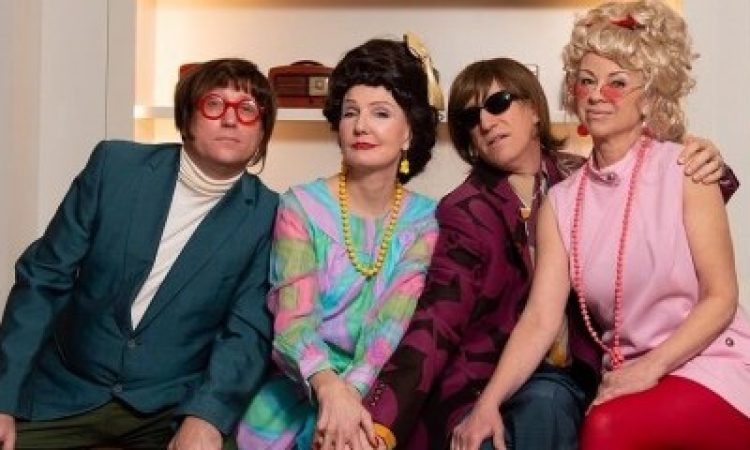
This blending of realities, characteristic of avant-garde works and paralleled in the diegesis as the distinction between fictional stories and real events crumbled, was not only engaging as a theatrical device but also particularly perturbing (in the best sense) here. The play is hilarious in its absurdity, to be sure; but it also raises troubling critiques of social hierarchy and bourgeois culture. The couples Smith (Brock and Bob Schmidt) and Martin (Sonja Robson and John Zak)—parodical French personifications of the English upper-middle class—are identified by their typical last names only, hinting at the hypocritical influence of lineage and wealth accumulation in bourgeois meritocracy. This critique reaches its apex in the Fire Chief’s last story, delivered skillfully by Carlos Forbes, which is about nothing but an expanding web of familial relations between people identified by surname and profession only. And yet, despite the importance of profession in social rank, we don’t know what the Smiths and the Martins “do” in life, other than consciously enact their boredom-inducing yet satisfying privilege, amusing themselves with the most mundane occurrences and continually searching for exotic entertainment.
In particular, Dura’s cross-dressed performance of Mary hit this critique home. Faithful to the play as written, Mary was the only one to speak directly to us. In this production, she was the first to establish the link between our world and hers by fixing drinks at the bar (presumably for her employers, the Smiths) before the play began, in costume but without full makeup. We thus saw the actor becoming the character—or was it that Mary decided to add some drag makeup to complete her look for her evening of service? The infantilization and reprimands she suffered at the hands of her superiors felt all the more discomfiting with the use of cross-gender casting. Indeed, the character was tragic even if her lines made little sense on their surface. The dismissive reaction to her nonsensical yet revolutionary poem about everything (even fire) catching fire seemed to confirm the repressive tendencies of bourgeois (heteronormative) hegemony.
The degeneration of language into sound without meaning, and the failure of dialogue to follow logic (or perhaps the characters’ indifference to the statements of their interlocutors), resonates today. IRC’s current production provokes timely meditation on these subjects and simultaneously offers a reprieve from their depressive effects. The actors all brought their roles to life in distinct and endearing ways within the production’s mod aesthetic (costumes by Erica Hoelscher) and delivered their repetitious lines with excellent timing. And, despite my initial apprehension, the final scene was more playful than savage.
To join the conversation, follow thINKingDANCE and Theatre Philadelphia online and on social media to read, share, and comment.
The Bald Soprano, The Idiopathic Ridiculopathy Consortium, Bethany Mission Gallery, February 6–16.