Annielille Gavino,* known as Ani, is a Filipino choreographer, community organizer, and movement artist based in Philadelphia. She is presenting Patawilion October 18th and 20th at Asian Arts Initiative. Awarded the Leeway Foundation Art and Change Grant and the Performing Artists + Asian Arts Initiative Mini Residency, this multidisciplinary installation aims to immerse audience members in Filipino-American stories, rituals, and culture, with the ultimate goal of teaching the Tagalog language. We sat together at Urban Movement Arts to talk about her upcoming project, vision as an art maker, motherhood, and history as a mover.
Amelia Rose Estrada: Can you introduce yourself and tell me about your early experiences with dance?
Ani Gavino: I am Annielille, and as I always say I colonized my name a few years ago, and it is now ‘Ani,’ which means soul or harvest. I am from the Philippines, and I started moving from a young age. I was in Philippine folk dancing because it was part of our physical education. We could either do sports or folk dancing, and I always picked folk dance. I ended up in ballet by default because my mom thought it was what I needed.
I did not think I was going to dance [professionally]. That was not a career my parents would have considered for me. I was studying for [tourism] management, and I started to dance again because something traumatic happened back home. I wanted healing. I had stopped dancing at that point, so I joined a company, and it provided a sense of familiarity and stability.
ARE: Can you share a little bit about your experience coming to the U.S., dancing in the U.S., and how immigrating impacted you as a person and artist?
AG: I moved to New York by myself. I was young and brave and fearless at that time. I always think that as I get older there is a lot more fear with risk taking than when I was young.
I met Milton Myers, and I demonstrated for him for many years. He was the one who encouraged me to go to the Ailey School. At that time, I would tell people that as an immigrant you go where you fit in. I have always been soulful, and I love storytelling. I didn’t realize at the time there was a coined term here called Black Dance—but that is where I felt that I fit in. So, I auditioned for companies under the Black Dance umbrella.
I apprenticed with Philadanco, and then I went to Cleo Parker Robinson Dance and then Dallas Black Dance Theater. For a long time that was my world of dance, but now I am finding who I am. I was assimilating and finding commonalities with others, but now I am digging into ‘Who is Ani, and how does she make her mark?”
When I first came to the United States, I remember wanting to find more Filipinos. My accent was so thick, I think they made fun of me. They called me FOB (fresh off the boat). I met someone at a bar who spoke Tagalog—that is not even my indigenous language—but I was just happy he was speaking it. He came back an hour later with his white American friends and I spoke to him in the language and he made fun of me and said, “I don’t speak that language.” I am just seeing I was once in that place, and now Filipinos are reaching out to me. I want more Filipinos to find me and have space to celebrate us.
ARE: What drives you to create, and are there stories you are trying to communicate?
AG: Lately, I actually haven’t been as dance driven. My choreography is centered around the Filipino story. Filipino is such a big word because we are such a mix. I like digging into pre-colonial and post-colonial [stories], and then there is the other layer: Filipino-American. Those stories are different from first to second-generation and so on.
I am trying to find people who want to dialog and process this through art in whatever way. Maybe storytelling, painting, drawing. I keep digging as to how I can use every element. The art making is on the surface and the deeper layer is that we all investigate who we are.
ARE: Can you talk about your upcoming project Patawili?
AG: I tend to pick up a book and let the spirit come to me. This book is called SIBOD by Maria Muyco and she talks about the indigenous people of my island of Panay. One of their rituals is Patawili, which is where they harvest and cook the food together. They sing, pray, and dance together. I didn’t realize this term before even though I am from that island, but I cited the word Harambee. Cleo Parker would always say “this is our Harambee, this is our circle.” I thought, “Oh, I totally know what this is, and I can’t believe I didn’t know what it is to my own people.” So that was my inspiration. I want to create this gathering—this circle.
We obviously don’t live in agricultural land, so my process was to farm stories. I slowly built from there. I picked up another book because I was losing inspiration. This time it was a children’s book, a mythology about Bighari who is the goddess of the rainbow.
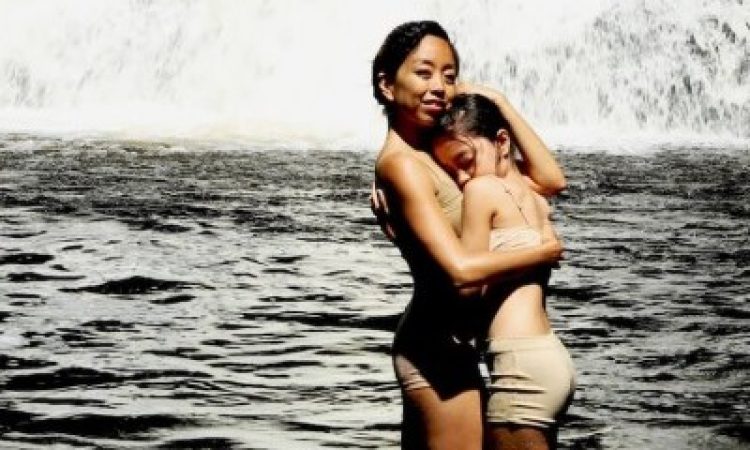
It is a story I use to read to Malaya [my daughter] when she was little. Bighari’s story is that she gets disconnected from the heavens and falls to earth. She creates the arch of the rainbow to connect back to her family—that is such an immigrant story! The rainbow is our culture and linage.
Asian Arts is allowing us to provide food from Lalo—a Filipino restaurant and we will have this experience eating with our hands called Kamayan.
What I want with my choreography is to find a space and a place for people to feel grounded. I have a Leeway grant for this project, and I am using it to make more films and have potlucks and teach the language. It is not always about dance. I don’t even think I am a dancer sometimes. It is just my vessel because I ended up in it.
ARE: How has being a mother impacted your artistic practice and how is Malaya involved in your work?
AG: I actually didn’t start choreographing until she came. I never felt the need. I danced for very technical companies. At one point in my life, I just wanted to move and dance and be a machine. But when [Malaya] came I started to think, “What am I teaching her? How do I raise her now?” I am trying to order Filipino books. I speak to her in the language, but she is not picking it up because I am the only one. She is really my impetus because I am trying to create a circle for her. I realize there are many others like her who feel othered because they are in between spaces.
I started choreographing with her as a way for her to learn her culture. I didn’t want to be this mom who is just like “learn your culture, learn your language.” I want her to enjoy the process. I ask,“Hey you want to make a show? You want to be the narrator?” and she is like, “Yes! I love narrating.” If she is speaking it, I feel like there is going to be ownership in that; she is proud of what she does and that is important.
*Ani is a new writer for thINKingDANCE
Patawili, Annielille Gavino, Asian Arts Initiative, Oct. 18 and 20,