I grew up thinking of museums as places where hushed attendees stared at static works of art—paintings, sculptures, drawings. But, back in the early-to-mid eighteenth century in the U.S., performance was regularly within the scope of the entertaining education that museums aimed to provide. In recent decades, museums are reviving this linkage, seeking to infuse not only their dedicated auditoriums, but their halls, lobbies, stairways, and galleries with active performance. The Philadelphia Museum of Art (PMA)* has placed itself squarely in the mix—or remix. Its October edition of Friday Remix, from 6:00 to 10:00 p.m., offered attendees circus, poetry, dance, and music, all capped by a DJ-driven dance party (too loud). The performances occurred throughout the museum, from the Grand Stair to the medieval cloister to an elevator, allowing each spectator to organize our time, space, and choices.
My journey began in the “Vaulted Walkway” with Almanac Dance Circus Theatre. The six white-clad dancers literally rolled onto the hard stone floor of this exquisite hallway, which leads into the museum from the new north entryway. A clump of indistinguishable bodies initially, the protruding arms, feet, necks, and butts eventually disentangled to deposit one dancer at a time down the length of the space, as we spectators lined ourselves along the walls. In an exhausting, daring, controlled unfolding of moves, the dancers worked in various groupings to tumble, vault, backbend, climb, and hand-walk through the space. Supporting each other in their balances, they shaped their bodies around one another, tilted against the soaring walls, and sometimes ran right up those walls. The audience, moving along to follow the action, often got up-close-and-personal, observing dancers’ concentration, weight-sensing, and sweat. It was a relief to see the piece, at times exciting, conclude with no splats on that unforgiving pavement.
I detoured from dance offerings to listen to the Arcana New Music Ensemble playing works by 1960s Fluxus composer Ben Patterson in the second-floor Resnick Rotunda amid Van Goghs, Gauguins, and Cézannes. The musicians—bass, cello, violin, and percussion—set themselves equidistant around the rotunda’s edges, allowing audience members to look over players’ shoulders at the idiosyncratic musical score (circles, arcs, triangles, and squares), or to sit in the center of the space and let the sounds ping at us from all sides.
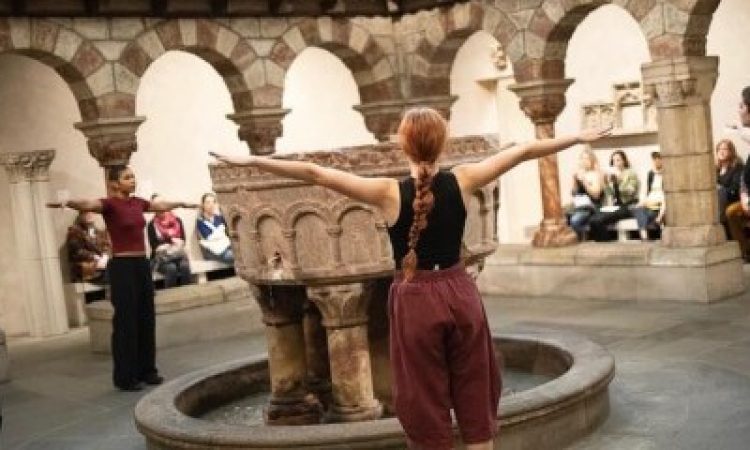
My last choice for the evening—and the clear highpoint—brought me to the third-floor medieval wing, where fidget presented “Enclosure…wellspring…retreat.” Beginning in a tight group, the five dancers retreated in peeling, backward-moving formation from the noise and hubbub of the Great Stair Hall performances below. Led by director Megan Bridge,** they arrived at an enormous wooden crucifix to melt into an angelic tableau. As the other dancers exited, Bridge invited us into an adjoining room with arches and ornate columns, where we found the dancers seated, back to back, resting heads on partners’ shoulders, as one beamed a flashlight at the ceiling to reveal the heights and bas-reliefs. Several audience members accepted the dancers’ quiet invitations to experience the seated, partnered light-explorations. The rest of us moved into the medieval cloister, gratefully (after standing all evening on hard museum floors) taking seats along the edges of the reconstructed courtyard. When they entered, the dancers circled the central fountain, then danced along the low wall that enclosed it, and bent toward the floor, their arms in elegant, mysterious hieroglyphs as they joined and departed from unison phrases. Far enough now from the noisy Great Stair, I became aware of Peter Price’s evocative music—bells, flowing water, clicks, growls, howls, sighs, and songs. At times, the dancers engaged in private moments of ritual—prayers, purifications, spells? Joining hands one by one into a line of angled women circling the stone fountain, they brought to mind the closing death-dance in Ingmar Bergman’s film, The Seventh Seal. These saintly witches, their spell woven, separated quietly, melted to their knees, and bowed.
*thINKingDANCE has covered PMA performance-related work in, among others, these stories: Dance on Paper at the Philadelphia Museum of Art; Dance as Spectacle: Le Super Grand Continental Takes the Club Outside; Aerobics and the Bee Gees Confront Titian, Picasso, Duchamp at PMA; May I Have This Dance, By Chance?
**Megan Bridge has been a writer and editor for thINKingDANCE. Composer Peter Price, also of fidget, was a writer with thINKingDANCE in 2011.
Friday Remix, the Philadelphia Museum of Art, Oct. 11