BalletX has a lot of energy, as Artistic and Executive Director Christine Cox makes clear in her curtain speech. She bounces in her stylish heels, introducing the three new BalletX works we’re about to see. (They’ve had over 75 world premieres as a company.) She even asks us to cheer for the performers backstage, reminding me that all of these skilled professionals were at one point likely getting cheered on in dance school recitals by their peers and families, a warm thought.
First is Off the Canvas, choreographed by Katarzyna Skarpetowska, inspired by Cy Twombly’s Bacchus paintings. When I see these paintings, my first thought is not ballet. Twombly’s red splashes and swirls seem more akin to the work of post-modernists like Trisha Brown. In Skarpetowska’s version, the women bourrée onstage, swirling onto the white marley (ah, canvas), standing tall with arms by their sides (ah, paintbrushes). An abundance of port-de-bras mimic Twombly’s loops, which are literally depicted in Fritz Masten’s costume design. The piece contains some arresting moments—a swinging lift where one dancer is brought upside down until his head almost touches the floor before being launched skyward again—but I spend most of the time wondering about the choice to intercut recordings of a Vivaldi cello concerto with Adrian Klumpes’ dissonant tracks, Cornered, Alone, and (appropriately titled) Why.
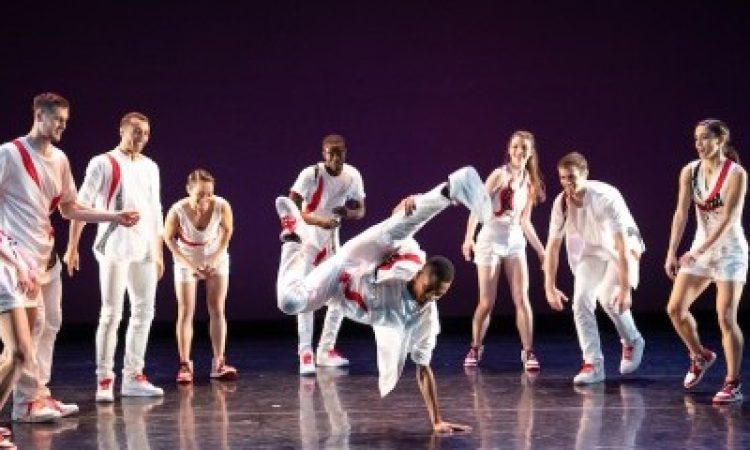
Onward, then, to Express, choreographed by Memphis Jookin’ phenomenon Lil Buck. Memphis Jookin’ style, sometimes called “Urban Ballet,” features toe-walking and gravity-defying spins, priming it for an interesting dialogue with the mechanics of ballet. Express triumphs in Buck’s ability to play the dancers like a jazz musician, having them hit and embody different instruments: the thump of the bass in a bounce, the piano’s tinkle in a burst of finger movement. Stanley Glover dances his solo to St. James Infirmary with the same ferocity he brought to his memorable So You Think You Can Dance audition. Glover holds an imaginary ball of energy between his hands, focusing intently on its movements around the stage, until his concentration explodes into an asymmetrical split leap. He lands, stretches into a luxurious penché, then breaks at the knee to hang limp. While some of the dancers struggle to make this new vocabulary appear natural, Glover melds Jookin’ and ballet seamlessly, exuding that quintessential element of coolness.*
The standout of the night, Nicolo Fonte’s Steep Drop, Euphoric, is a gleefully dramatic and technically challenging closer. Lights come up on the face and torso of Chloe Perkes, suspended in midair, the most striking opening of the program. Upstage of Perkes, a strip of white marley flooring hangs from the ceiling, ending in a roll on the stage. Diagonally downstage, a row of theatrical lights are hung low overhead, in sight of the audience. As the dancers whirl around in gauzy neon pink and green, clawing the space with their hands to the relentless strings of Ezio Bosso, these theatrical set-pieces put my mind at ease; there’s a self-awareness of the high drama of this choreography. Perkes delivers an emotional solo, pushing herself forward across the floor, unspooling the roll of marley with her pointe shoes until it stretches across the stage, before rolling herself up in it. She runs the length of white, and hurtles up the panel vertically (the illusion assisted by her fellow dancers). Fonte plays with the rolling musicality and deep silences of Bosso’s music. Just as we can hear the musician’s breath and the attack of the bow in Bosso’s recordings, we hear the breath of the dancers and see the power and fluidity of their movements. Half the company sits as audience to watch the rest dance under the theatrical lights, and I’m reminded of my earlier imagining of all these dancers’ recital years. This is what dance can be, Fonte seems to be saying, and isn’t it glorious?
*See Brenda Dixon-Gottschild, Digging the Africanist Presence in American Performance: Dance and Other Contexts. Westport, Conn.: Greenwood Press, 1996 (paperback, 1998), 11-19.
Spring Series 2019, BalletX, Wilma Theater, March 6-17.