For an evening thematically centered on loss, the Wintry Mix overflows with excess. Performers from various pockets of the Philadelphia arts scene join Nichole Canuso at Bryn Mawr College, engaging the audience in radically varied works. Some grapple with grief and its ample weight, while others celebrate the frivolity and joy of shedding the undesirable.
As we walk into the theater, we are handed cards and pencils:
What is something you’ve lost?
________________________
What is something you hope to lose soon?
________________________
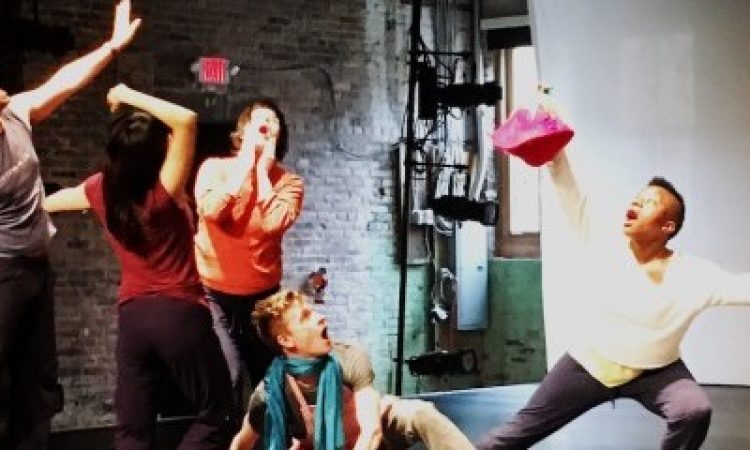
Several dancers take the stage, then take our cards. They sing: “What did you bring with you? We’ll take that, you don’t need it anymore!” Audience responses become lyrics. My mother. My inhibitions. My faith. My obsession with politics. My youth. My desire to check Facebook. The lost we honor; the present we desperately hope to lose. We are watching Nichole Canuso’s Processional, and its toggle between heavy content and levity is an apt introduction to the ensuing lineup.
Deeper into the show, Nichole Canuso’s solo excerpt Sneakers is a standout, a gentle work in which Canuso dances a series of repeated gestures to a recorded soundtrack of words which whisk us into a childhood home, like “countertop” and “guinea pig.” She tells us how her mother came out to her when she was a preteen, a quiet conversation at the kitchen table shared with a quiet audience at the theater.
Tumbling onstage after an ensemble piece, Adrienne Truscott’s Short/Form dazzles me and leaves me thinking in a different way. In it, Truscott performs self-proclaimed “feminist comedy.” Sporting a large t-shirt, hot pink stilettos, and at least six overlapping bras, she struts onto the stage to Tag Team’s “Whoomp! (There It Is)” while crunching cheetos. “Aw, I stepped in shit!” she screams, pulling her foot out of a bag to reveal a life-size plastic Trump head impaled on the end of her six-inch heel. After a set of purposefully cheap jokes about blowjobs, abortions, and Louis C.K., Truscott ends by sliding into a bare-legged split, a small sign reading “BLACKOUT” dangling from between her legs. It’s an exploration of a specific identity in a show which, as a whole, reminds us of its ever-changeable nature.
Even with its medley of content, the performers’ camaraderie gives the evening the overall feel of an album rather than a collection of disparate singles. Jennifer Kidwell traces lines with her arms alongside Meg Foley and Helen Hale, before reappearing as a lecturer-turned-cop-giving-a-lap-dance along with Jess Conda in A Hard Time. Chelsea Murphy and Rhonda Moore form soft statuesque shapes before Martha Graham Cracker and Eliza Hardy Jones join them for a feel-good dance rendition of Kate Bush’s anthem, “Running Up That Hill.” Performers without onstage obligations take seats quietly among the audience, appreciating their peers. The collective holds itself through the waves of solemnity and delight.
Wintry Mix, Nichole Canuso and Friends, Hepburn Teaching Theater at Bryn Mawr College, January 24.