Photo: Stephan Takacs

“…not a fucking swan…”

Zornitsa Stoyanova

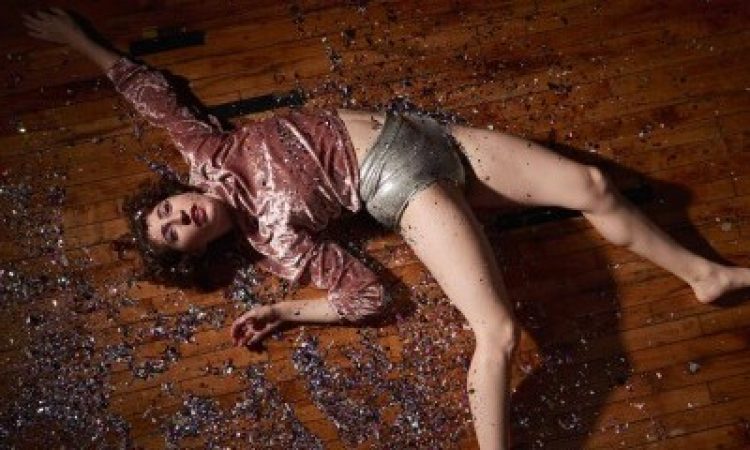
A pair of dancers (Margot Electra Steinberg and Mary-Carmen Webb), anonymous and unmoving with foreheads on the wall and one hip relaxed, are positioned in the far-left corner. Across from them a black clad body (Celine McBride) enters. Her legs bare, she moves forward in an illusion of over stretched “Barbie” strides wearing a silver party wig. The fake hair obstructs her face and she becomes a sexy poodle, moving into forward bends, long lunges and shakes.

As rhythmic beats (music by Liam O’Connor) start to pump, the unmoving pair animates. All three come together to giggle and hiss in a caricature of girlishness, every facial expression contrived. Their arms reach through the waist of their skirts to pull out glitter and I laugh out loud — a “pussy” party in full swing.

A pillow fight spills white feathers and trash everywhere. “I’m not a fucking swan” one screams, and a trio version of Swan Lake’s four cygnets proceeds. In formation they embrace, fake laugh, hold hands, and pet each other. Screams and screeches, a face of anger, displeasure, giggling and cackling color the constant angular movements and high kicks designed to show legs and buttocks.

All their emotions are too stylized and fast fleeting, I wonder who these young women are. Denied their real affect by the design of choreographer Paige Phillips, I am all too aware of the limited pop culture archetypes we as women are often stuck with.

Après moi, l’obscurité (After me, the darkness) by choreographer Paige Phillips, Mascher Space Cooperative, Jan. 26-27.

Share this article

Zornitsa Stoyanova

Zornitsa Stoyanova is a multidisciplinary performance artist, writer for thinkingdance.net and a mom of two little boys. She is an editor and staff writer with thINKingDANCE.

PARTNER CONTENT

Keep Reading

Dance Leadership by the Numbers

Jennifer Passios

A Conversation with Elizabeth “Liza” Yntema of Dance Data Project®

At the RISE 2025 Summit held at the New York Library for the Performing Arts, panelists for a discussion entitled “Data is Revolutionary” gather in black office chairs with silver legs in front of a large projector screen that reads “Dance Data Project, Harriet Tubman Effect Institute, & Women Count” in a pastel blue above the title “Data is Revolutionary” in a light yellow. Six circles containing the headshots of the panelists dot the rest of the projection. Amidst the other seated speakers, Nancy Owen stands holding a microphone in her right hand. She leans forward toward the audience, eyes alight, mouth open in speech that slips through an excited smile. In the lower left corner of the frame, a bald man in a crisp blue suit brings the crook of his thumb and second finger to his chin at stage right. He looks out toward the audience with his chair angled away from the six panelists.
Photo by Victoria Detres

Meanwhile, in an Indoor Meadow: An Interview with Andrew Skeels

Caedra Scott-Flaherty

A new dance and exhibition explore growth and change in an intimate setting.

Andrew Skeels, a White man with buzzed hair, wearing a black T-shirt, stands against a black background. He is turned to the side but looks directly out with a soft smile.
Photo: Damian Siqueiros