In November 2011, science writer John Bohannon delivered a TED talk that since then has made the social media rounds—especially among dancers. His “modest proposal” was that scientists eschew their go-to technology of PowerPoint presentations and hire dancers to illuminate their talks instead.
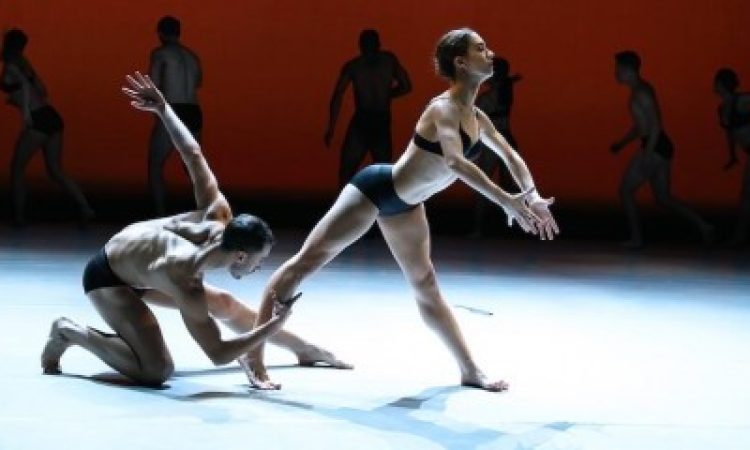
In BalletX’s second of three works for its winter series, R. Colby Damon turns that proposal on its head, making a lecture the centerpiece of his premiere On the Mysterious Properties of Light. Dancer Zachary Kapeluck delivers this monologue in several different accents while moving in response to—and also in illustration of—the language of lay science (Neil DeGrasse-Tyson and Brian Greene are quoted). Eventually, he is joined by the precise and explosive Andrea Yorita, and then others. The result is riveting, and demands a different type of attention from the audience: dancers’ expressive and technical skills are put in service of esoteric concepts that themselves become a prompt to watch human bodies differently. The descriptions of quantum entanglement and spooky action at a distance (truly miraculous properties that link the behaviors of non-proximal subatomic particles) enrich the fully-danced sections that follow. The unison turns and leaps of partners split from one another no longer seem “exquisitely rehearsed” but instead innately connected. The “shared origins” discussed at the molecular level become a metaphor for all human connection.
Jo Strømgren’s The Letter is also a lecture of a sort, though a less convincing one. The quirky set-up for this blues-scored romp is a voice-over of a young choreographer moving to the big city and writing home to “Grandpa” about his experience making dances there. Despite several humorous moments (the dancers—dressed in long black wigs, ripped black jeans and vests—at times partner each other at lightning pace but also flop like dying fish on the ground), the premise falls flat. The down-home wisdom delivered via canned Southern accent amounts to an admission that the fictional choreographer has no idea why he makes what he makes. And the eventual strip-down, with the dancers losing their wigs and most of their clothes, feels less like a revelation and more like a cynical about-face: the attempt at faux-homespun irony shifts into a display of dazzling athleticism with little if any attempt to connect to the previous narrative. It is as if Strømgren is saying to the audience, “You think you want meaning, but what you really want is pure physicality—here, let me show you.”
Matthew Neenan makes a similar argument—for the pleasures of a more abstracted approach to composition—effectively in the first piece of the evening. In Credo, performed to live musicians’ rendering of Haydn’s String Quartet Op 76, No. 1, nine dancers move in and out of large choral-type sections to create a sense of communal ritual. The piece begins lightly, with pantomime-like posturing and tableaux that both echo Romanesque statuary and gesture towards Paul Taylor’s Cloven Kingdom—in sensibility if not direct vocabulary. As the piece draws on, unison breaks down, relationships develop, and a sense of drama ensues—without explicit narrative. The seamless partnering and Neenan’s use of breath and suspension in the duets provides at least one sublime moment: a dancer, turning with leg extended, catches her partner by the neck in the crook of her ankle, and yet nothing stops; they continue unwinding, eventually dissolving their brief association.
Power, speed, and the technical wizardry of talented and committed dancers were evident in all the evening’s works. But it was the musicians onstage during Credo, and not the other pieces’ lecturing voices, that argued for an older kind of magic: the kind that happens between live performers across disciplines. Such connections are in and of themselves illuminating. They shed light on one of the most profound reasons for making—to connect. My modest proposal: a return to/more of this.
BalletX Winter Series, BalletX, Wilma Theater, February 10-19.