Lynn Matluck Brooks is a thINKingDANCE writer and editor. Christopher Brooks, a violinist, composer, and improviser, has worked with dancers Lynn Brooks, Beau Hancock, and Tori Lawrence. Together, they saw and discussed programs 1 and 2 of Facing Front. This essay comprises elements from this conversation.
They sit facing us, the audience that has collected, and we face them—Jonathan Burrows and Matteo Fargion—on the opening night of their rich Philadelphia residency (their first in this city, including multiple evenings performing different works), presented by Thirdbird. They are two middle-aged, balding, friendly-seeming guys in jeans and short-sleeved shirts, their notebooks on the floor in front of them. They launch—quietly, precisely—into a series of textured gestures: knock, stroke, swing, slap, open, close, clap, swipe, wipe, wave, flutter, count, point…. They unfold their work—jointly created, jointly performed—with unpretentious, polished precision.
Watching, I recall Anna Drozdowski’s comment in Thirdbird’s press release: this work is, indeed, “‘handmade’ and ‘human-scale’” and I am utterly drawn in to Both Sitting Duet. Reading from their own scores, each uniquely notated by the artist as they created the piece in 2002, Burrows and Fargion move through their complex, fixed parts, alive to the moment, as in any fine performance. As chamber musicians respond to one another’s body language, expression, and musicality, Burrows and Fargion are sensitively strung, cuing one another, breathing together, listening, watching. Using techniques of musical composition (i.e., canon, variation, motifs), Both Sitting Duet is a gestural translation of Morton Feldman’s 1982 work for piano and violin, For John Cage. Because of Feldman’s interest in patterns and repetition, rather than in melody and harmony, the translation (which avoided any effort to reproduce the original work’s pitch) is particularly direct and effective, drawing our eyes into the complexity of gestural interplays and subtle sounds like brushing or clapping.
The performer’s light wit, good humor, and friendly glances at the audience are far from clowning or goofy, yet several audience members erupt in loud laughter. At the talk following the performance, led by Michéle Steinwald, Burrows remarked on the laughter, noting how differently audiences around the world respond to particular moments. They also mused about the initially “disastrous” reception of the piece at its premiere.
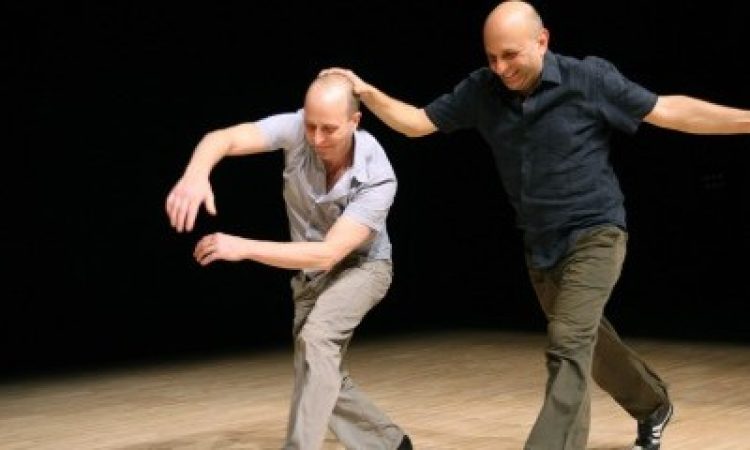
Part 2 of the evening began with The Quiet Dance (2005), a mostly standing-and-moving piece that carries the players across a shallow diagonal from left to right and back, and sometimes also around in arcs and circles. One staggers in a measured lunge as the other sings “Aaahhhh” or whispers “Shhhhhh.” Light runs, loping circuits, hands-held (or hand-on-head) contacts sometimes carry both men together across the stage. The trajectory of their levels, their stage paths, and their vocalizations gently move from high to low: it is all aslant, off-kilter—yet in a friendly, collegial, unthreatening way. This work, like the others in the program, is a highly complex and intellectually rigorous unfolding of material that reveals its strategies, inviting the audience to figure it all out, to anticipate or respond to new material, to enjoy the virtuosity and commitment of the performers. At the same time, Burrows and Fargion are responsive to one another, to the moment, as well as to the audience. Fargion particularly reveals his experiences facially: what he finds funny, when he wants to match Burrows, how he prepares for exertions. Burrows’ face is a bit more in dancer-glaze mode, but just a bit; his reactions, although more contained, reveal that he too is alive to each moment.
Speaking Dance (2006) closed the evening. This work adds extended riffs of spoken language to the musical and dance materials. It opens with rapid-fire repetitions, sometimes overlapping between the two performers, of “right, right, right, right…” and “left, left, left, left….” The words morph into similar sounding words, or those related by type or meaning, as the performers introduce gestures that they share between them, transform, or abruptly change. Again, the work is built on subtly shifting patterns, but now employs a richer palette of materials, including recorded music, Fargion singing Italian folk songs and later playing a melodica, and both performers playing harmonicas. Burrows gets some busy, if standing-in-one-spot, movement solos to Fargion’s singing and playing.
These three chamber works require an intimate space and an attentive audience. Christ Church Neighborhood House, and the crowd in the seats facing the stage, provided just that ambience. We do, however, have just one minor complaint: The placement of the performers in the first and last pieces was too close to the audience area; with the steep rake and narrow rows for seating, those in the upper levels typically had partial or blocked views of the action. Owing to the subtle visual complexity of the works, this left many viewers out of the picture.
Facing Front, Christ Church Neighborhood House, June 19. Facing Front continues June 26 and 27 with different performances each night. http://www.birdbirdbird.org/facing-front/#facing-front-overview