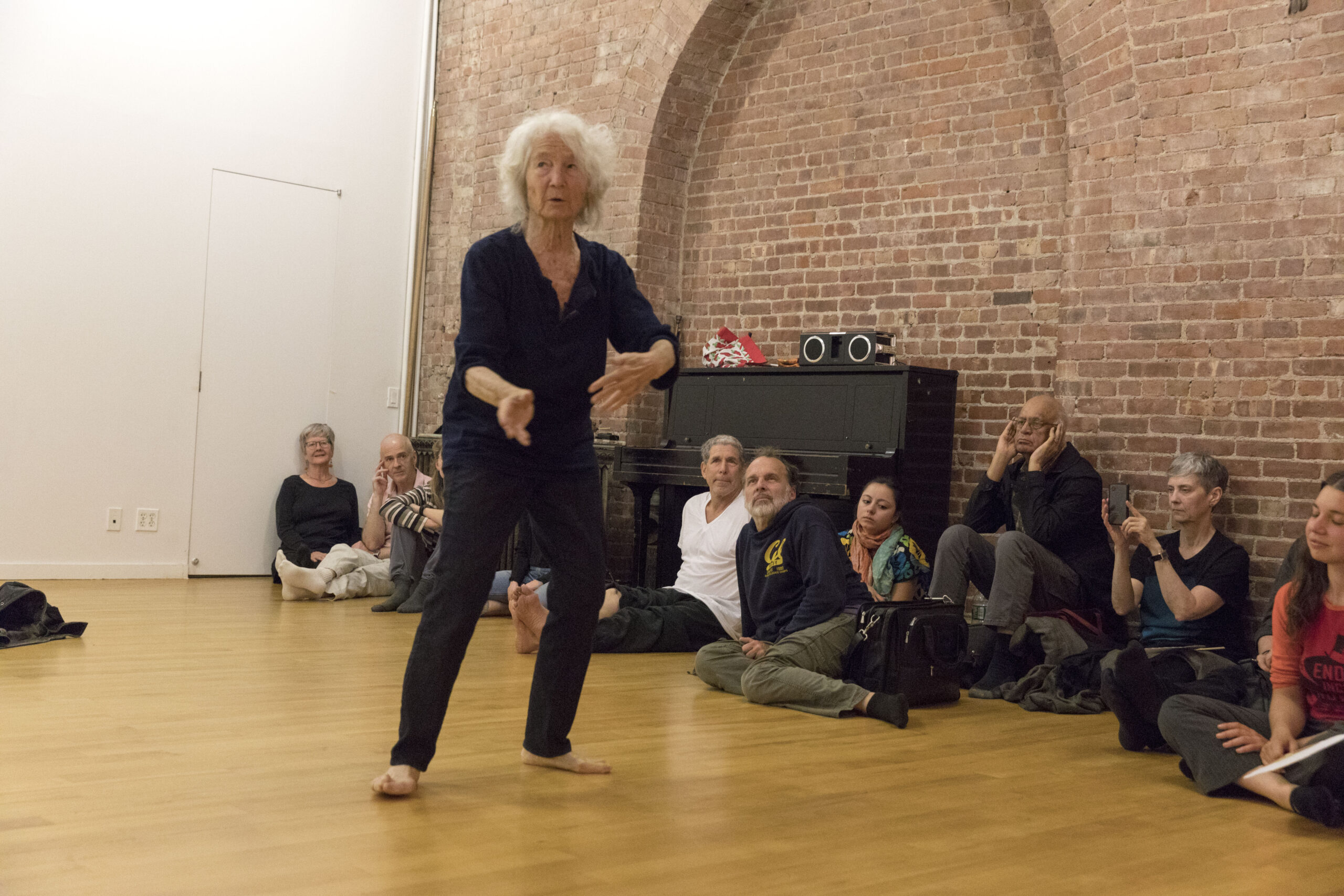
In our workshop with Kirsten Kaschock, she offered several mind-bending exercises. One involved assembling reviews by writing sentences about a piece in four ways: emotional responses, declarative descriptions, summaries, and questions. We cut them into strips with one sentence each, scrambled them, and handed them off to another TD writer to make a written review.
Our notes from the workshop (with contributions of notes from Whitney Weinstein, Jonathan Stein, Lisa Kraus and Lisa Bardarson) have been compiled in this way, below:
Sometimes your ending could be cut up to be used up front—as it represents your process of getting to what you think about the piece.
The History of English in ten minutes on YouTube.
English has generated around 3 or 4 million words, from the history of the language, conquest wars, Shakespeare, King James’ Bible, scientific revolution, imperialism, the internet.
Use the richness and diversity of this language.
Write short, declarative of what you saw. Get materials first. You can use the tools of composition later.
Being able to plan is good, or going with the flow is good. Or start with a strategy opposite your usual.
When reviewing, fill a page with sentences that begin This reminds me of…
Rules you might hate can be broken:
Not using passive voice. But you can because it denies agency. Both are useful: 94% of the class failed the test or the test was failed by 94% of the class.
Verbs of being can be powerful
Use but instead of however (which is more used in academic language)
Two-part constructions don’t need to be shied away from.
It’s okay to start a sentence with because
Transitional language sets you up for so much—it positions your thoughts and leads us through the path of the language: however, rather, if…then.
Similes and random juxtapositions force you to think about things outside your usual frame.
We have internalized journalistic convention so much because we have read it so much.
Get beyond the restraints of straight declarative sentences and journalism’s self-imposed restraints.
Repetition can be good.
Sentence fragments can work.
Intensify repetition using sound. Connect, use their shape (how does it feel in your mouth?)
Put yourself in the character, on the stage of what you saw—write a paragraph as a way to get images.
Physical process—change where, how and when you write.
There’s a kinetic base to how we speak. Throw physicality into writing practice. E.G. write immediately after some activity: yoga, Pilates, exercise. Perhaps put yourself into the performance on stage.
“Inner 5-year-old”-in between every sentence ask “why?” Makes you ask yourself if there’s more the reader needs.
Why don’t we ask the questions that are so obvious – “Why don’t people ‘get’ modern dance?”
Random and free association makes you think outside normal parameters, it gets juices going.
Create page of questions. Create strange juxtapositions.
To change it up, change where you’re writing. Write with a pen.
Read your piece aloud.
If you’re stuck, grab something to bash against: “dance is like a bridal shower…”