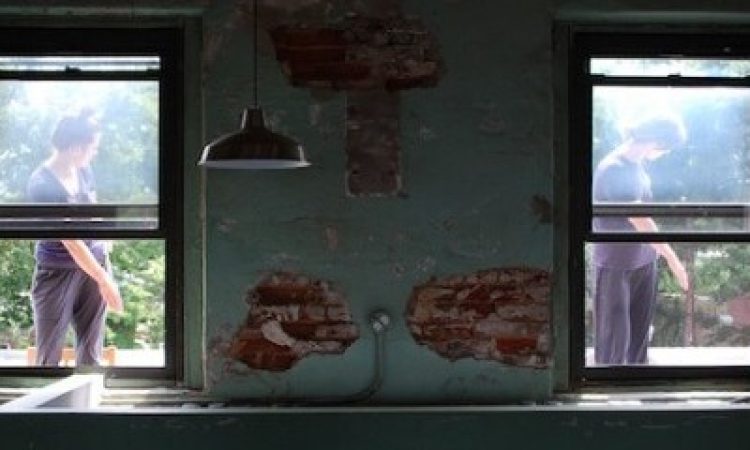
It might be the beginning or the end of the piece when Andrea Lanzetti, Ashley Lippolis, CrystalNicole, and Elizabeth Weinstein are all standing outside a window of The Iron Factory, on the roof, moving in, out, and between frames in turn. The lights in the actual indoor space are off; each dancer is lit from above by a bulb with the softness of moonlight and the eeriness of being deep underwater. They all face in. Then Lanzetti strides over to CrystalNicole to be hoisted, hips over shoulders, and placed down adjacently. The four pass each other and slip in and out of our vision with kaleidoscopic rhythm and symmetry; each individual movement is a shift in the larger pattern, each reach of an arm mirrored a few windows down. It’s something like a sideways cascade.
Have I mentioned that a lecture by Alan Watts about time, called Time, is played all the while? The words and cadence are abstracted by Adam Vidiksis until the text falters for undetermined periods of time and, finally, it descends into unrecognizable sounds, no longer English, just rhythms continuously beating. By the time it resurrects itself toward the end of the work, Watts’s words have lost almost all meaning, having been repeated to the point of oblivion (and effectively so).
Unlike the edits of the sound score, which transitions linearly from point A to B to C, Lora Allen’s choreography traces one long run-on sentence. The dancers swoop into each other, laying themselves with almost melancholic nonchalance across one another’s backs, each movement exactly what it is and nothing more. Transitions in the work might be parsed, considering whether the dancers are inside or out on the roof, in the main space or a smaller alcove of a room—though the seams between pieces are so finely threaded that they flow as smooth as silk. I am continuously impressed by the “is-ness” of Allen’s choreography and the dancers’ performance: how each gesture is simply done and not demonstrated or satirized; how Lippolis merely lifts Lanzetti so she can grab hold of a shelf at the level of her head and swing freely for just a moment; how each of them arrive where they need to be, do what they need to do, and the system churns on.
As Allen’s title suggests, and without giving too much away, the perception of events and responses as separate instances may be inadequate. There is no beginning or end; there is only a dancer moving another along and the way two bodies fit together when one sits on the other’s knee, side by side.
Then The Tail, allendance, The Iron Factory, September 8-10, 2017. http://fringearts.com/event/then-the-tail/