The practice of making performance in order to understand identity and culture more fully has always been compelling to me. So, when the FringeArts Festival announced their curated line-up, the show that was etched into my schedule first was nora chipaumire’s piece portrait of myself as my father.
Since I have yet to see her work, I immediately dove into research. On the show’s FringeArts website, there is an interview with chipaumire and a link to a video that speaks more directly of her artistic practice. But, what I can tell you is this: such a highly personal embodiment of a father-that-was-never-known by stepping into the frame of African masculinity feels daring and brave. It takes audacity to direct attention to a place that ultimately is imbued with self-confrontation.
nora chipaumire (whose name is usually written in all lower case) is a Zimbabwe-born artist currently residing in New York City. In an interview for a 2012 piece entitled Miriam, she speaks of living in “self-exile” as a way to more fully understand herself: “there is something in [the] condition of exile that allows for another [way of] thinking. […] I’m putting myself into the fire just so I can understand.” This sentiment captures the essence of what I expect in witnessing her work. And, I do use the word “witness” intentionally; there seems to be a dedicated purpose to chipaumire’s work that requires the audience to bear the truth of what is being excavated: the roots of her self-understanding.
In previous work, chipaumire has, as Claudia La Rocco of The New York Times described, aimed to “complicate traditional and stereotypical images of African women,” and to do it in a way that expects the audience to meet her halfway. Using dark, obscure lighting, and objects to traverse, she is presenting the audience with the opportunity to reach into the experience by fully investing in the extremes. And now, she is tipping to the extremes of masculinity for perhaps the same purpose: to upend stereotype by going into it.
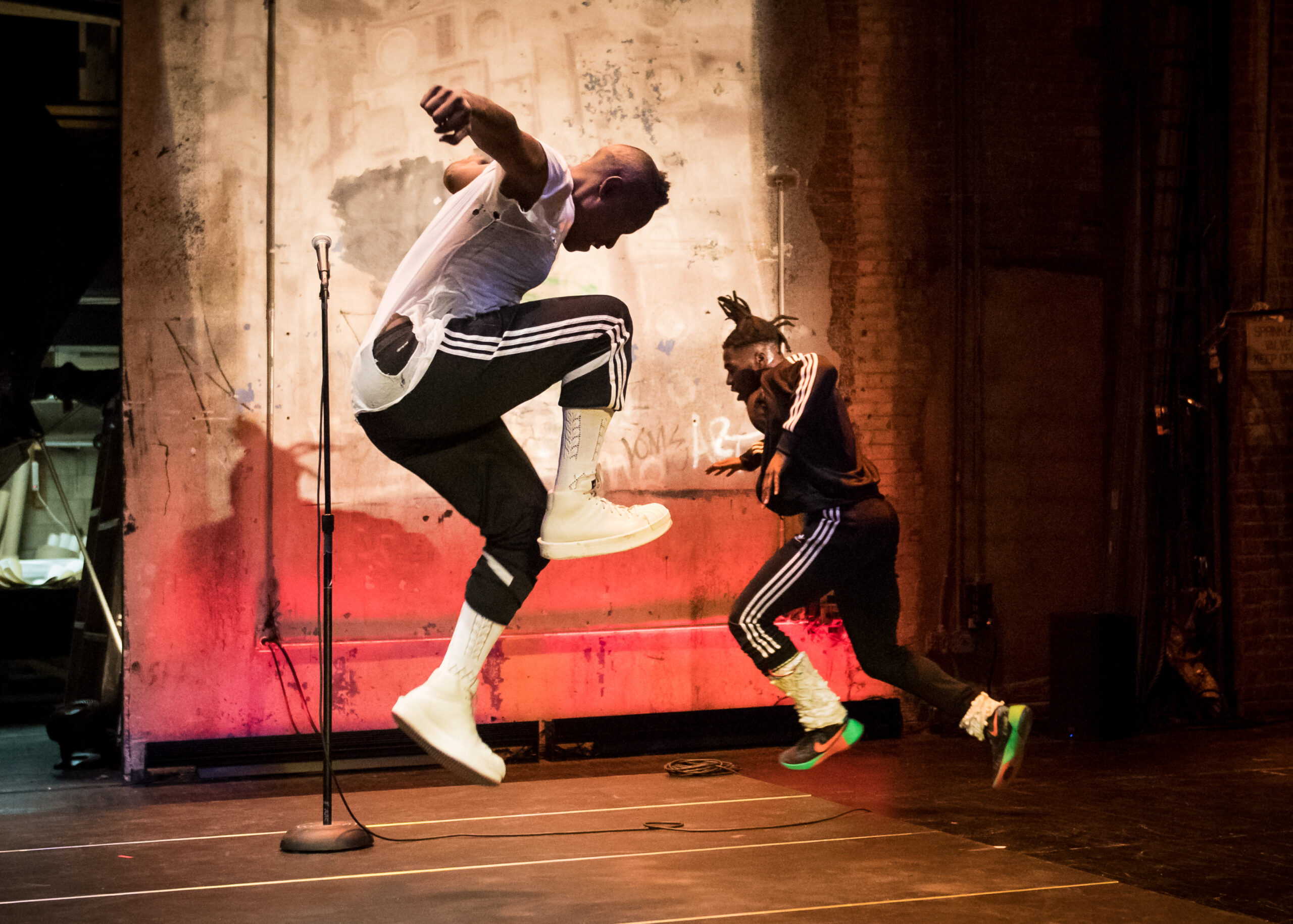
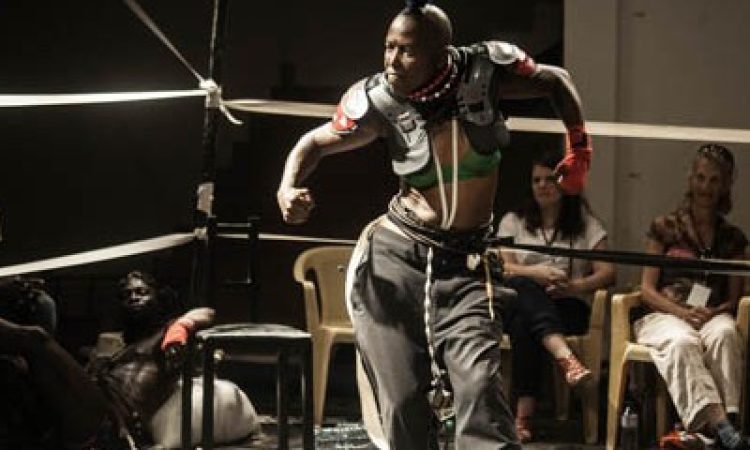
Likewise, this current piece will utilize objects as obstacles—such as straps that keep the characters tethered to each other. It also draws from the stylings of Sapology (African men’s fashion movement); the prized personas of boxer, runner, and intellectual; and Coupé-Décalé (popular République de Côte d’Ivoire/Ivory Coast dance music) to construct an image of not only a specific man, but also a man that can be a universal expression of African masculinity that she/we will have to contend with onstage.
Presenting and representing the story of a black African male is not separated from layers upon layers of history and identity—political, religious and cultural—that might seem to need tender handling when presented to an audience. But, in a review of rite riot, a companion piece to portrait, Ivan Talijancic writes, “Chipaumire is not interested in politeness. She acts quickly and ferociously[…] audiences have the same ability for self-confrontation and honesty; her presence creates a mirror for us to zero in on and examine our own assumptions.”
It is looking at these assumptions and stereotypes that has me so geared up as we near the opening of portrait of myself as my father. How will the exploration of masculine physical language arrive and inform this particular female body? How much does masculinity/femininity vary from or align with one another from culture to culture? As an American audience, what will we see of ourselves? And, might we try to be as brave and as willing to confront our own questions about male-ness, father-ness and black-ness while we witness?
portrait of myself as my father with nora chipaumire, Pape Ibrahima Ndiaye a.k.a. Kaolack, and Shamar Watt, Sept. 23 and 24, Perlman Building Terrace at the Philadelphia Museum of Art, http://fringearts.com/event/portrait-of-myself-as-my-father-2.