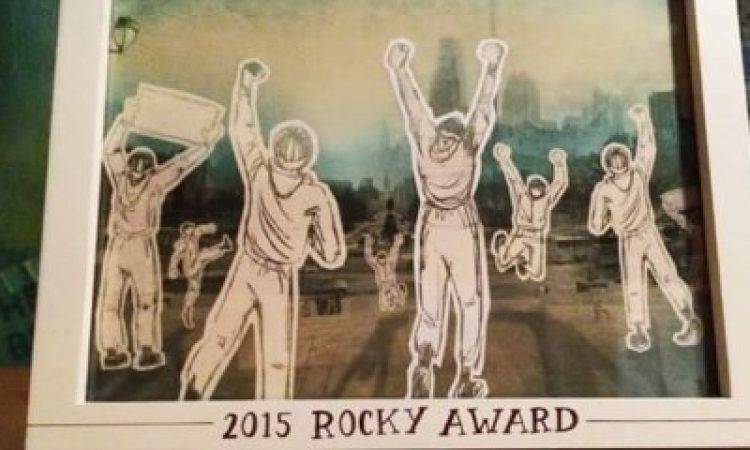
The Rocky Awards is an annual cabaret-style celebration from and for Philly’s dance community. “Rockies” (the awards) are informal—they signify love and appreciation for an artist’s work and they are passed from person to person year after year. The theme of this year’s show—A Funeral—referenced both the closing of the Philadelphia service organization Dance/UP and the Philadelphia Dancing for Justice* protest that ended the evening.
Melanie Cotton and The Women’s Revolutionary Vagime opened the show. Yes, vagime: “like regime and vagina put together,” Cotton explained later. She entered the stage leading a group of women marching and j-setting** in close formation. All were dressed in unbuttoned one-piece uniforms, exposing different colored bras—sexy and militant. They dipped their hips suggestively, at one point twerking towards the floor, in a stereotypical image of female sexuality. The intention of the work was unclear to me. If Cotton’s goal was to celebrate feminism, I question her success. However, I would see any show just to steal another glance at her stunning and powerful presence.
Annie Wilson and Christina Gesualdi, the MCs, entered with amazing grace, carrying a life-size cut out doll of Pope Francis, who visited Philadelphia just a week before. Their exaggerated lyrical movements and lit-up faces were accompanied, predictably, by Madonna’s Like a Prayer. Like the release of this song decades ago, the Pope’s recent visit caused controversy; Wilson and Gesualdi’s over- the-top dancing addressed those moments of unease with subtle yet powerful sarcasm. Their brilliant delivery left me wanting more, unsure whether to cringe or laugh.
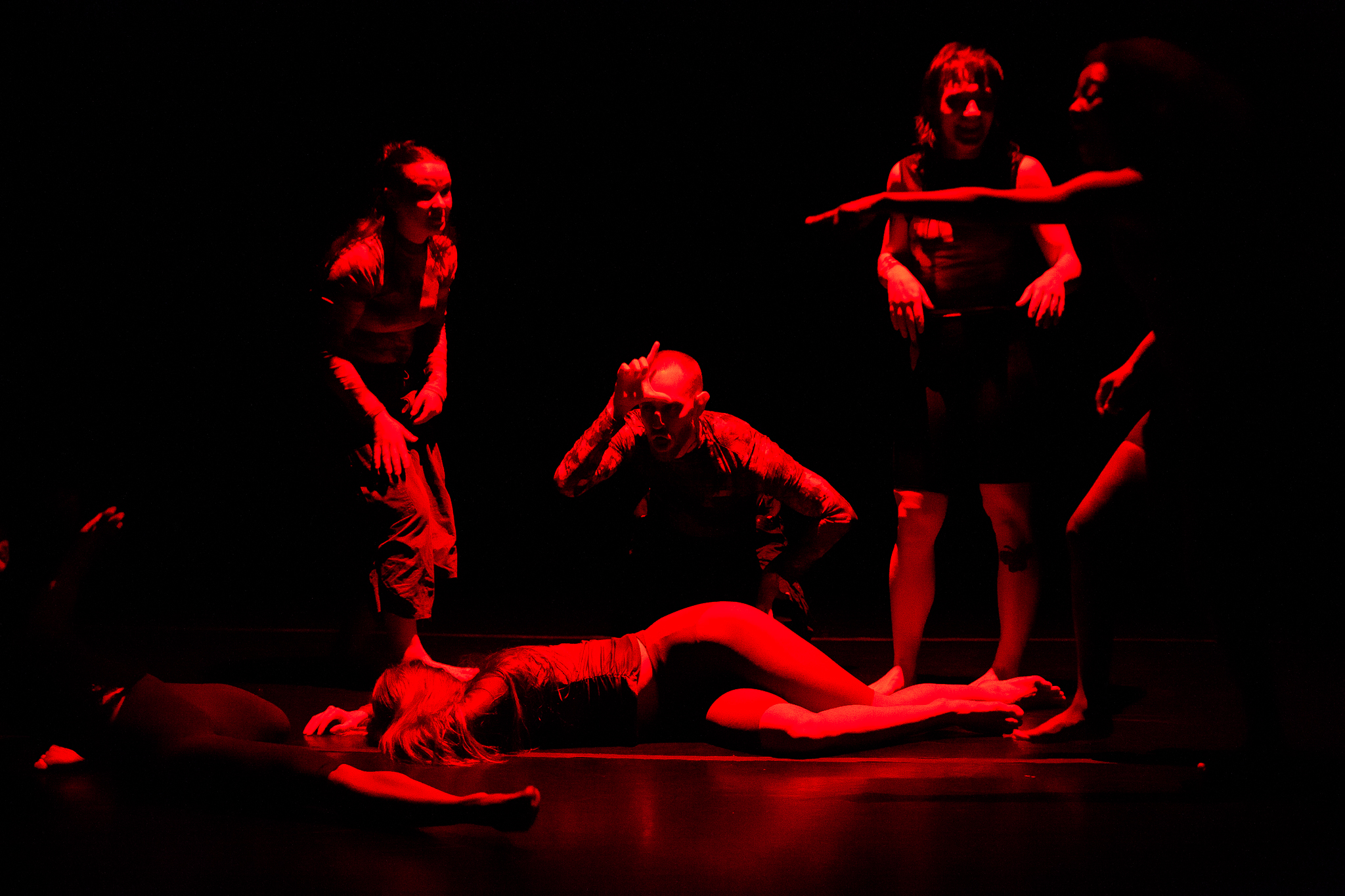
Another highlight was Asimina Chremos’ performance lecture, Impermanence. Solemn, focused, self-aware, and funny, she first broke the word apart and finally illustrated her own impermanence with a representational death. I wanted to see it again, to understand it better. I was so taken with her smart and eloquent language, it made me want to be her artist friend.
The night continued with artists presenting awards to other artists. Some bestowers and recipients were missing from the room but present on video, with one acceptance arriving from as far away as China.
Pasión y Arte’s Elba Hevia y Vaca performed a solo flamenco with a live singer and guitarist. She was subtle and present, in deep dialogue with her trailing skirt. As she inhaled, bringing her gaze down and slowly lifting her arms up, my breath hitched. She was grace, her uncanny ability to bring me along on her journey unquestionable.
We also watched a video presentation of Dance/UP’s restructuring from a service to an all-volunteer organization—from the dance community and for the dance community.
As the evening came to a close Jumatatu Poe directed all who were present to participate in a Philadelphia Dancing for Justice protest. He entered the stage singing and walking with arms outstretched above his head in surrender. Eventually everyone joined and made their way outside the theater in unison—singing and dancing in protest of the horrible realities black people in this country face. It was dark and freezing under the Ben Franklin Bridge; I shook from cold and emotion. As the group recited the names of people killed just this year by police, my tears flowed freely. It was fitting and ironic to be next to the bridge named after the Founding Father who helped Jefferson hone the Declaration of Independence’s iconic phrase “all men are created equal.”
I tried to track the extreme discomfort in my body and imagine what discrimination and injustice feel like physically. What would it be like to know you are dying without ever having done anything wrong? I sensed how impossible it was to fully embody or understand that.
We entered the warm theater and hugged each other, drank beer, and talked about art and its diminishing funding. The discomfort I’d experienced outside was gone so easily, and I felt guilty. I also felt shame and confusion. I never identified as “white” until I got to this country. As I try to piece out what my skin color stands for here, I sense how others see me, and I sense how I am automatically linked to a larger history of privilege and racism.
The night left me elated, sad, hopeful, and very proud. I revisited my anger, at continued injustice and ignorance in this country. I witnessed real care and love in this city and in our dance community. I felt sad for the loss of our beloved Dance/UP and hope for what is to come.
We all buried something that night and left hopeful and empowered, looking for change.
______________________
The 2015 Rocky Award winners:
Gus Gscheidle
Cory Neale
Raphael Xavier
Gary Jeter
Will Robinson
Danielle Currica
________________________
*Philadelphia Dancing for Justice – “Dancing for Justice Philadelphia was created in 2014 to show solidarity in the dance community around the unarmed killings of Black people in the U.S.”
**j-setting – “J-Setting has evolved to also become the name of the style of dance and dance culture that is modeled after the dance formations, movements and dress style of the ‘Prancing J-Settes.’ It originated in the late 1970s from African-Americans in the Jackson, Mississippi, area of the United States.”