Ed. Note: In this piece, Jonathan Stein discusses a lecture by Xavier Le Roy at the University of the Arts and Le Roy’s Retrospective at the MoMA. In a linked piece, Stein discusses some of the ongoing performances Le Roy’s MoMA exhibition has made possible by presenting his own choreographic explorations as springboards for other artists’ work within the museum over two months.
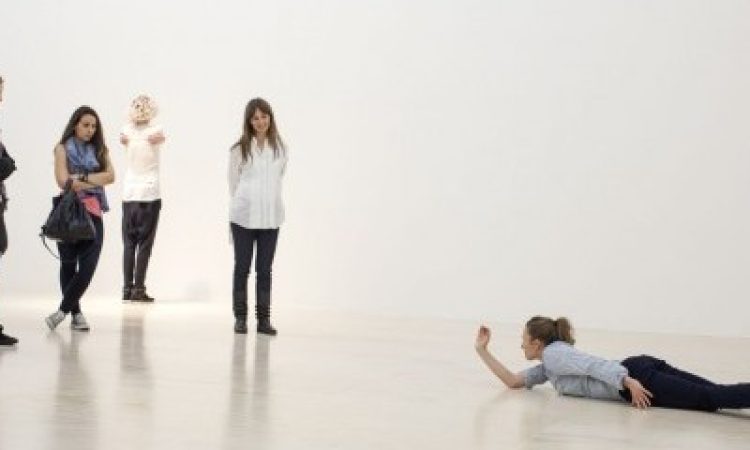
When I walked into choreographer Xavier Le Roy’s Retrospective at MoMA PS1 there seemed to be nothing happening. And there certainly were no objects to look at in the brightly-lit gallery.
Earlier in the week I heard Le Roy talk at the University of the Arts in Philadelphia about three of his past solo dances. How, I wondered, can a choreographer have a retrospective in a museum without restaging the works?
At MoMA PS1, I received a disorienting welcome—my very entrance triggered a vocalized alarm from motionless performers in the corners of the room. The performers scattered out of sight, then re-entered on all fours, approaching and encircling every new group of visitors. An engaging game commenced as the dancers stood around me calling off particular years, I would later learn, that corresponded to Le Roy solos performed between 1994 and 2007, the source material and structure for Retrospective.
I DONT WANT
NO RETRO
SPECTIVE
In his anti-authorial coup, we see a collective retrospective intertwining the lives and work of Le Roy and his cast, and with uncanny ease, upending almost every aspect of the traditional museum retrospective. Retrospective does not present iconic creations draped in male ego to be devotedly reproduced. Le Roy’s solos become generative of new work by the multigenerational cast of 16 dancers working on-site over a course of nine weeks. The spirit of Los Angeles artist Ed Ruscha’s drawing, I DONT WANT NO RETRO SPECTIVE (1967) lives on here.
The encircling dancers dispersed, one at a time, to either sit, nestle, or sprawl near a wall in a static sculptural position of their choice (perhaps related to a Le Roy work or an homage to the object-centric soul of the museum). Another performed a solo movement excerpt, likely one chosen from a Le Roy work. Another, warmly encountering some visitors, began a highly personal, charming, and interactive autobiographic conversation/dance following the form of Le Roy’s own “portrait of an artist” lecture/performance work Product of Circumstances (1999). In Le Roy’s Product, he related that—after obtaining his doctorate in molecular biology at the University of Montpelier in the early 90s—he was pursuing science research as well as beginning to take dance classes, and he lost the belief that science offered “the right of access to truth and to a different world.” When he became a dancer, “thinking became a corporeal experience.”
At the University of the Arts
At the University of the Arts, Le Roy spoke about three of the solos underlying Retrospective in his talk, “Production and Reception of the Visual in Choreography.” Although no longer a practicing scientist, he spoke with the analytical rigor of one, illuminating his working processes for Narcisse Flip (1994-1997), Self-Unfinished (1998), and Le Sacre du Printemps (2007). (Philadelphia FringeArts audiences in 2011 saw a similar work, More Mouvements fur Lachenmann [2008], investigating what can be heard, seen, moved and imagined among musicians using gestures to render the scores of the 1970s musique concrete of this German composer.) After setting forth the methods by which he created each work, Le Roy went on to reveal how he learned and performed them, and how the work was interpreted by audiences. In a captivating presentation, he established the relationship between audience perception and artistic process, “What you experience is not only what you see going on but what are all the steps in the process. How you work [as an artist] is as important as … the movement you create or intend to create.”
Retrospective, he added, is an effort to “make process visible, and shared, and includes the activity of working as a subject of the exhibition… [T]here is a tension, since the performer is replacing the object. The question is how much do I become an object.” Le Roy elsewhere has described the work as a “choreography that is an exhibition and an exhibition that is a choreography.”
The heart of the choreographed exhibition at MoMA PS1 is the interaction of intimate story/performances with audience members in diverse groupings. Le Roy’s prior work gets transformed through the individual interpretations of each performing artist; over nine weeks their narratives and performances reflecting their own lives as dance artists will serve as the material for the individual cast of artists. Each monologue concludes in a sudden frozen posture or gesture, casting a fictional dream-like veil over the experiences spoken and portrayed.
In an adjoining gallery where dancers took their breaks, audience and performers could hang out together—either to watch Le Roy videos or engage in further one-to-one conversations. A third enigmatic space that a few of us wandered into appeared entirely dark and empty. After some time, our eyes slowly adjusted to the darkness and we either discerned or discovered via touch—at the base of walls—three human-like figures entirely covered in greyish fabric. They were dummies from an earlier work, Untitled (2005), presented anonymously by Le Roy as an “unknown” artist with no title, description or photos. This gallery was the black hole of the retrospective, left to mystery and our darkest projections.
Knowing Dance More: Xavier Le Roy, series curated by Laura Bakst, University of the Arts, Oct. 15, 2014, http://www.uarts.edu/events/2014/10/knowing-dance-more-xavier-le-roy; Xavier Le Roy, Retrospective, presented at MoMA PS1, Long Island City, Queens, Oct. 2—Dec. 1, 2014,http://momaps1.org/exhibitions/view/388