Ed note: In this piece, Stein discusses some of the ongoing performances Xavier Le Roy’s MoMA Retrospective has made possible by presenting his own choreographic explorations as springboards for other artists’ work within the museum over two months. In a linked piece, Jonathan Stein discusses a lecture presented by Le Roy at the University of the Arts and at his own response to Le Roy’s exhibition at the MoMA.
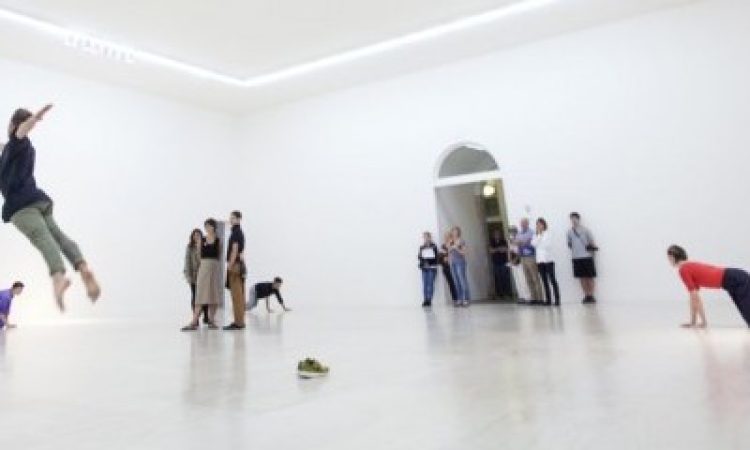
Xavier Le Roy “makes process visible” in his choreography/exhibition, Retrospective, through his cast of sixteen intergenerational dancers who mine the content and forms of his earlier body of solo performances, 1994-2007, then add to them to create their own life/dance retrospectives over a nine-week period. The form allows the PS1 audience an intense and personal engagement with these individual life stories and dance excerpts, culled from both the cast’s own and Le Roy’s work. Because these performers’ retrospectives will be changing over the two-month life of the exhibition, the artists and audience will experience art itself as de-objectified process, impermanent but vital.
On a recent Sunday afternoon and during three hours as a visitor to Retrospective I was swept into the individual retrospectives of several of the dancers.
Ben Evans (see his photo on homepage) has performed in three of the past seven iterations and has written of his Vienna workshop experience of Retrospective in the Brooklyn Rail. In his story/performances, Evans offered personal anecdotes which tracked the years of Le Roy’s solos in parallel with his own developing interest in dance and performance. Evans danced an imitation of the youthful Bob Fosse, with eyes projecting to distant balconies, and related his studies of the Grotowski technique into the spectator and viewer experience.
Eleanor Bauer performed a segment from Le Roy’s Le Sacre du Printemps with both explosive chest pops and pianissimo gestures directed towards us, the imagined orchestra members playing the Stravinsky as she conducted. To create this work (that was also performed in excerpts by other PS1 performers), Le Roy viewed Simon Rattle conducting the Berlin Philharmonic, then used Rattle’s movements, augmented with others he composed, for a choreography of the music score. Bauer segued from her Sacre to a monologue delivered in a Southern drawl from At Large, her own investigation into what is performance. Both Le Roy’s and Bauer’s work shared a wacky physicality and penchant for the ridiculous. At a later point, Bauer’s roots in the ridiculous were revealed as she performed her first dances from age five. These were created for Michael Jackson’s Bad and of Smash Your Head into a Wall, musical selections to which—with a laugh—she attributed her first attachment to entertainment and conceptual art.
Bryanna Fritz and Takahiro Yamamoto deftly knocked out excerpts from a work they described as Le Roy’s Gisselle, a swiftly cut montage of popular culture images that ran the gamut of a Jesus Christ crucifixion, a sexy Brigitte Bardot, some six-gun cowboy action, and a Michael Jackson pose. Yamamoto told me and another visitor that, for the first time in this—the third week of the run—he had inserted into his story/performance a new, personal anecdote: as an adolescent in Japan his youthful infatuation with a boy band helped meet a longing for individual expression and performance absent in his home town. After offering, for a few of us seated on the floor before him, an earnest song and dance (heavily indebted to Michael Jackson) he made a swift, intuitive leap into the pop world dance segments of Le Roy’s Gisselle, where Jackson again flashed his hips. My last glimpse of Fritz was in the adjoining gallery, wearing headphones, studying the Sacre movements from a Le Roy video, quite oblivious to our presence.
Dance veteran Columbine Macher, who provided balletic elegance to her life’s stories and dances and those of Le Roy, summarized the experience of the performers by speaking movingly of the choreographer’s “generosity and openness to his dancers” allowing them to take his work and respond to whatever resonated with them.
Le Roy’s is a retrospective as an on-going, active art process, visible and transparent. His work suggests that art’s raison d’etre may be generative: the creation of new art. Here what is presented are artists, in a vibrant collective, at work, in lieu of artworks presented—in typical museum mode—as the cool, fixed objects of a solitary creator. The generous privileging of influence and response (rather than product) was a refreshing contrast to my experience just the night before at the closing of the Jeff Koons retrospective at the Whitney Museum—organized in the usual manner of a canonical art museum retrospective and capped by a night-time Koons book signing attended by adoring millennials lining up around the corner of Madison Avenue.
Le Roy dissolves the art institutional hierarchies, “exhibiting” a generosity of spirit to his cast of artists, and welcoming and befriending visitors as co-participants in the developing process. By taking advantage of the museum’s conventions that offer the visitor freedom to move at will, Le Roy taps this vein of the institution’s circulatory life-system, a boon for the audience’s curiosity and imagination that may be proscribed by the constraints of time and space in theater-based performance.
The constant bubbling creativity and careening dynamics of Retrospective proved highly intriguing, and yes, entertaining. This is an exhibition/choreography worth multiple visits. Who said conceptual can’t be fun?
Knowing Dance More: Xavier Le Roy, series curated by Laura Bakst, University of the Arts, Oct. 15, 2014, http://www.uarts.edu/events/2014/10/knowing-dance-more-xavier-le-roy; Xavier Le Roy, Retrospective, presented at MoMA PS1, Long Island City, Queens, Oct. 2—Dec. 1, 2014,http://momaps1.org/exhibitions/view/388