Color, a quintessential ingredient of visual experience, is sometimes bleached out of dance. Maybe it was the modern movement’s pursuit of abstraction—think Balanchine’s black and white—that allowed the choreographer to erase color and zero in on the body’s line and form. Perhaps the post-modern’s embrace of everything from the conceptual to the pedestrian relegated color to a subordinate status. Art historian David Batchelor’s Chromophobia chronicled the purging of color in Western culture and thought as an aspect of a “foreign body,” e.g., the oriental and the feminine, or diminishing it into the world of the cosmetic or superficial. In her book The Black Dancing Body, Brenda Dixon Gottschild critiqued the racial aspect of the derogation of skin color of Black dancers.
Yet at the birth of modern dance in America, Doris Humphrey’s Color Harmony (1927-28), her first work around an abstract idea, focused on the emotional effects and vibrations that could be generated by the manipulation of primary colors and color combinations. Color has been a quixotic and only occasional choreographic choice into the present.
Stepping boldly out of this history is Loren Groenendaal, a playful interrogator of ideas and sensations. She and her Vervet Dance company, in color FULL, ambitiously seek a “synesthetic celebration of color.” “Can color be heard? felt? danced? tasted?” she asks in her press statement, and even offered Drink-the-Rainbow cocktails at her Mascher Space bar.
color FULL had an appealing continuity of design. Its six sections of solos featured dancers in distinct monochromatic costumes, inventively designed or fortuitously chosen by Groenendaal. She confined movement within a six foot square space and engaged a different solo musician to accompany each dancer. Despite my best efforts at color consciousness or awareness, I found it was the sculptural and formal qualities of each dance that dominated the coloristic effects.
The opening Green section began in dimly-lit shades of grey with Katherine Kiefer Stark on her back, her entire body hidden within a costume where the arm sleeve openings connected to the bottoms of pants and formed intriguing loops. The lighting grew, and her green became more visibly present, a winter becoming spring, as she slowly emerged with exploring limbs forming dramatic symmetries. This bio-morphic, chrysalis-like apparition was supported by the mysterious tones of a Messiaen melody played by Melinda Faylor on accordion.
The Blue section presented Kelly Turner in a metallic blue costume encased within overflowing veils of translucent fabric. Her swirling turns on occasion offered a Loie Fuller flourish to her solo, accompanied by Paul Stern on wooden and metal flutes.
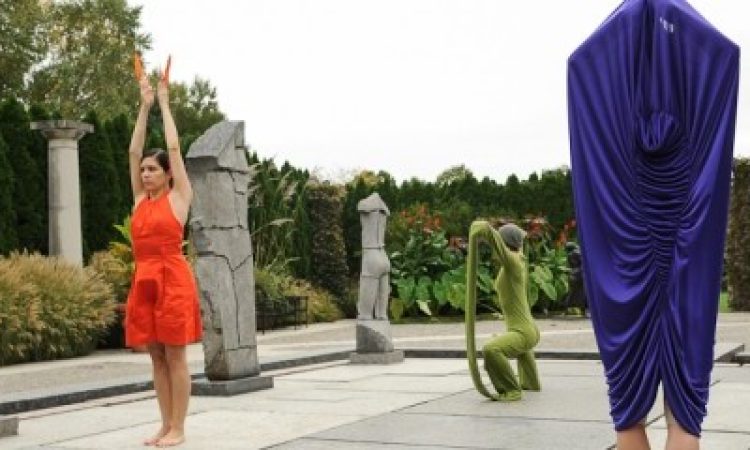
Megan Wilson Stern created a memorable Purple segment through her presence, concentration and calm classicism. She emerged slowly out of and submerged back within the deep purple, shirred fabric costume she wore (a knock-out, vintage dress found by the choreographer’s mother Susan Groenendaal). The costume’s rippling patterns added another layer of movement to Stern’s ever slow and constant rotations around her axis and her subtle extensions of her limbs that often formed asymmetries. The sounds from flandrew fleisenberg’s rotating pan lids mirrored Stern’s turnings as if the music was generated by her physical motion.
Red gave Stern the opportunity, in tight bright red, athletic attire that left arms and leg bare, to activate each square inch of the space through dynamic thrusts of her torso, jumps and spread eagle falls upon the floor with the active encouragement of Kyle Press’s alto saxophone.
For Orange the choreographer, in a simple orange halter dress (another vintage find), transformed herself with orange feather-like extensions that doubled the length of her fingers to give herself a Firebird persona. My eyes were always focused on those fiery hands animated by Groenendaal’s clipped, staccato body and arm movements. fleisenberg’s percussion suggested a world of insects and forest.
Exaggerating the human body with stilt-like extensions (actually crutches) within arm sleeves, Barbara Tait’s Yellow almost took flight as we could imagine that our arms had a prior life in evolution as winged appendages. Paul Stern’s cello added weight to this weird bird’s effort to escape her squared confine.
Throughout, the lighting design by Zornitsa Stoyanova provided subtleties of shading and enhancements of the rainbow color offerings.
The dancing body with imaginative costuming and lighting design held the trump card in this performance. But even if color could not reach the synesthetic heights of experience here envisioned by the choreographer, color FULL does suggest that the palette should be at the ready in the studio and in performance.
Color FULL, Vervet Dance, Mascher Space Cooperative, May 23-25