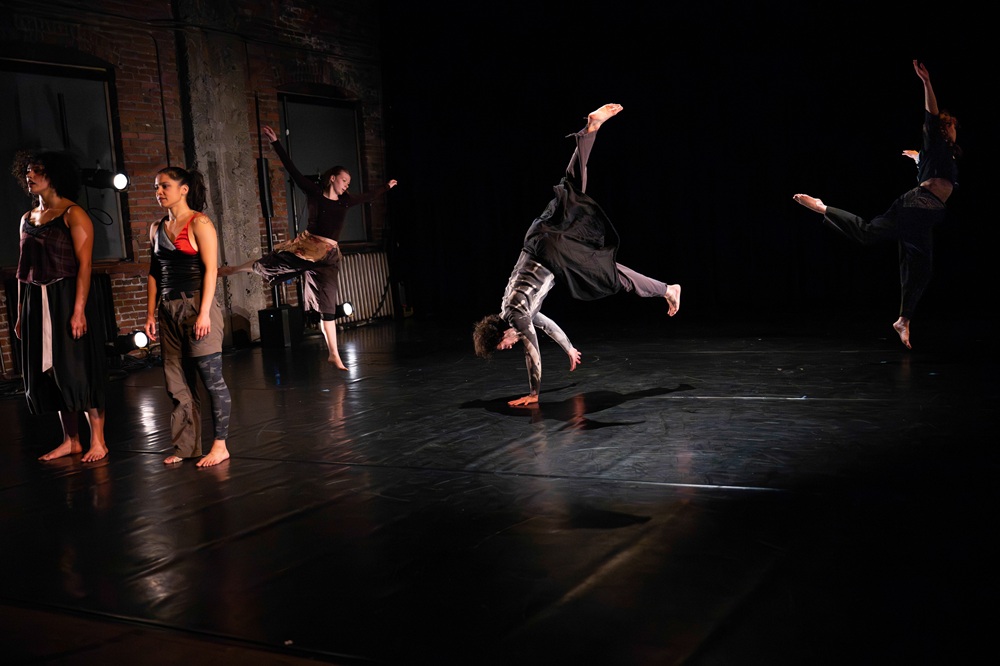
Headlong Dance Theater is known for its commitment to collaboration. Amy Smith, David Brick, and Andrew Simonet have been working together to foster a warm, personal approach to making performance since 1993. They ask big, messy questions, then dive in to their work with a daring sense of playfulness and experimentation. They share credit for the answers that surface. This has proved to be a stable model (they have made over forty dances) that has projected itself into Philadelphia’s dance and theater worlds as a sustainable, refreshing way to make art.
But it has been a while since Headlong has made a new dance together. In 2009, they invited veteran New York-based dance maker Tere O’Connor to both mentor and shake up their collaborative process for a piece entitled more. Smith, Brick, and Simonet didn’t perform in more., but now, three years later, they have returned (through the tides of individual artistic projects, life, kids, and administrative responsibility) to making and performing in a work together. On May 4-6, Headlong brings you Desire.
Using a vastly different approach than they did with more., with Desire Headlong turns inward, even looks backward. They have brought on director K. Elizabeth Stevens, a professor of acting and directing at Swarthmore. Early on in our phone interview, Stevens confessed, “I’ve never made a dance before.”
Stevens has been close to Headlong since the early ‘90s. In fact, she is married to Andrew (he was her first boyfriend ever). Desire investigates the four artists’ memories of being in their early 20’s. Stevens nostalgically recalled the period of time after college when she and Andrew were dating. Desire is saturated with “bittersweetness” — the futility and the joy of reclaiming the sentiments of times gone by.
I posed to Stevens, “What’s with the American Spirits cigarette pack on Desire’s postcard? You guys don’t smoke. Do you?” I could imagine the Headlong crew taking a break from rehearsal to drink herbal tea or snack on trail mix, but I could not conjure up an image of any of them puffing away outside of the Parlor, their South Philly company home.
She replied, “We made a couple of dances that involved smoking cigarettes because we all smoked back then. It’s a contemplative, moody thing to do. You can see your breath, a visual reminder of the passage of time….just like playing cards, drinking coffee, cooking with onions…It’s all somewhat of a memory jog. They bring us back to the place of being young artists scheming all the time about how to make art.”
Desire got its name and some of its influence from Bob Dylan’s album released in 1976 (although none of the songs from the album make it into the piece). Not surprisingly, Desire is known as Dylan’s most collaborative effort. At the time, Dylan had visionary, even romantic hopes for what it could be like on tour. This idea struck a chord with the Headlong crew who, in the ‘90s, were grappling with the idea of how to create utopian communities. (Desire is also inspired by other crazy dreamers R.E.M. and Sinead O’Connor.)
The work is a string of little mood pieces that don’t necessarily action forward. Stevens says making interludes like these is a welcome break from theater in which each play needs to move forward and pick up momentum along its trajectory. She likens the pieces of Desire to “poems or music videos of sorts. Each one hangs out in the moment for a while.”
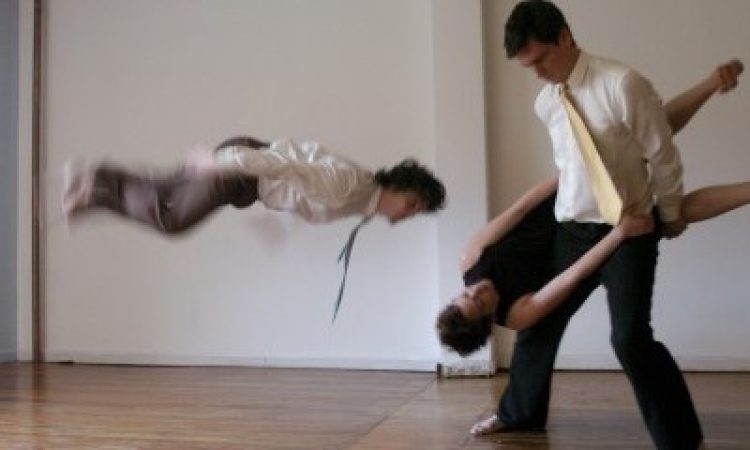
In two of Stevens’ favorite sections Smith, Brick, and Simonet enact movement that they didn’t invent themselves. For these sections, Stevens filmed her assistant director at Swarthmore as well as her 6 year old son Jesse doing spontaneous dances. She had the Headlong crew learn the material and perform it together: sped up, slowed down, and retrograded. “Both of those pieces look so haphazard. The source material is just someone goofing around, but when you see it translated by more than one body, you notice the precision and see how complicated it is.”
Stevens expressed admiration for the complexity and stability of the Headlong crew’s interconnected history. “They’re still longing-dreamy-artist-people with their feet on the ground, and all the while, they’re trying to levitate.”
Nostalgia figures prominently in Headlong’s oeuvre. “On a personal level, Desire feels like a real good meal — a little thin, nothing that lasts, making something out of smoke and mirrors. Maybe it shows the fragmentary passage of time…growing old, memories, and dying.” more. contained themes of mortality, too. After realizing that the exploration of past life experiences begs questions of future deaths, Stevens proposed: “Maybe that’s too heavy and sad a way to end!” Although it may have melancholy undertones, Desire is much anticipated and a piece whose end you can only experience yourself.
Headlong Dance Theater, Desire, May 4 & 5 (8pm), May 6 (3pm),
The Performance Garage, 1515 Brandywine St., $15. www.headlong.org