In his Poetics, Aristotle derided spectacle as the least important artistic aspect of a performance. RubberbanDance Group’s Gravity of Center shows that sometimes, spectacle’s all you’ve got.
Designer Yan Lee Chan took a blank stage encased in darkness and carved it into an ever-evolving visual sculpture of spaces delineated and circumscribed by shrouds, beams, and even fog formed by lighting. These spaces ranged from shallow caverns at the back of the stage to abstract urban landscapes of underpasses and street scenes, and at multiple points, directed the audience to peer over a precipice at the lip of the orchestra pit. Chan evoked, through light alone, a physical cause for the anxiety, wonderment and terror displayed on the faces of RubberbanDance’s five dancers.
Composer Jasper Gahunia’s underlying, though not well-integrated, electronica score trembled forward in growling bass lines and pitched notes suggestive of screams. The music reminded of a fugue—one filled with earthy colors, rich in emotive motifs and all served up on a synthesized track.
Critiquing a piece’s music as part of the spectacle begs a much larger question about what type of quality and degree of import music plays in a dance work. Opinions vary, ranging from an essentialist perspective of Balanchine, for instance, to Merce Cunningham’s attempts to disassociate music from dance. Here, Chan’s and Gahunia’s spectacular ornamental contributions far surpassed the lackluster choreography they decorated.
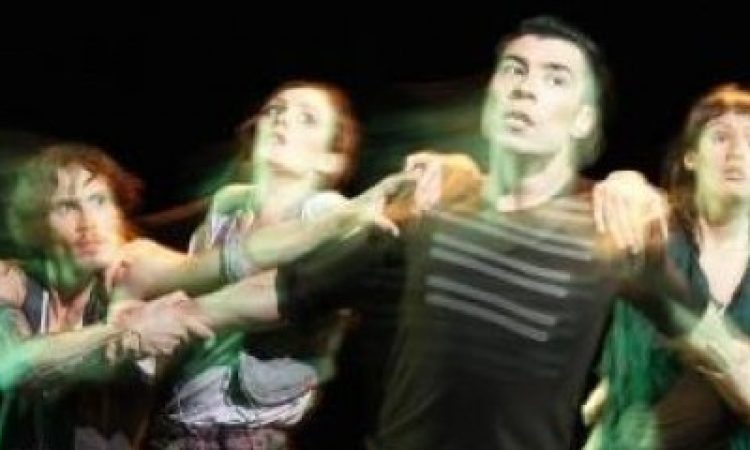
Choreographer Victor Quijada intended an exploration of “social issues stemming from the contrast between abundance and scarcity” (according to the program notes). On stage, he led a quintet of dancers that emerged from prone positions on the floor, the group awakened to movement by a red flare shooting in a diagonal arc across the stage. Each wore typical urban attire—sweatpants, pants, hoodies and t-shirts—and the collective ambled forward, teetering on light footsteps as they probed the space. Quijada kept his arms thrust back in a protective gesture as he extended a leg; once he stepped forward more confidently, the others mimicked him.
A series of struggles for dominance ensued. In Quijada’s loosely plotted narrative, male dancers Elon Höglund and Daniel Mayo each challenged him for leadership of the group, attempted to recover a woman he dragged away or fought to determine where the members ventured next. Hoglund and Quijada squared off, encircled one another with arms latched to the other’s shoulders and then Quijada leveled a kick at Höglund’s head. A scene later, Mayo and Quijada grappled in a similar fashion. Occasionally, the pair of combatants would push toward the lip of the orchestra pit.
These bouts would last until other group members arrived and picked sides, driving one of the combatants into retreat. And then repeat. And repeat. Sure, variations on a theme have inspired the best works of Bach and Rachmaninoff. But here, the iterations hung like popcorn on a string; each distinct numerically but not meaningfully, and even with a few small doses of capoeira and Brazilian Jiu-Jitsu thrown in, none of the combative interludes provided as much visual interest as Chan’s lighting.
Quijada compounded the boredom by setting the scenes and movements at a glacial pace. What could have taken 35 minutes he stretched to 80. Don’t get me wrong, I appreciated the display of strength required to perform balletic and hip-hop movements in slow motion. Hand-planting up to a one-armed handstand requires tremendous power when done with speed; here, Höglund had to hold himself perpendicular to the ground with an agonizing strain of force. But why strip your company’s signature fusion of ballet and hip-hop of speed, when that speed, at least, could have dazzled?
RubberbanDance Group’s “Gravity of Center” at the Annenberg Center, Jan. 19-21, 2012. No further performances