A light-filled mobile, electronic music, patches of light, and five performers who dance, speak, act, and finish the mobile’s assemblage—these elements are Connected, an hour-long production by the Australian group, Chunky Move. The mastermind pulling the strings that bind these elements is artistic director Gideon Obarzanek, the work’s choreographer. (In 2012 Obarzanek, the company’s founder, will pass the direction to Dutch choreographer Anouk van Dijk.) The visions of collaborators—sculptor Reuben Margolin, composers Oren Ambarchi and Robin Fox, lighting designer Benjamin Cisterne, and costume designer Anna Cordingley—weave integrally into the work’s fabric.
Two performers enter before the houselights dim, wandering casually onto the stage before a blast of music propels one into a rolling, flinging dance. The other sets to work on the low-hanging mobile in a steady, workmanlike progress. Other soloists, duets, and trios enter—some lusciously sensual, others zombie-like, half-dead. Sara Black, Ross MacCormack, Marnie Palomares, Harriet Ritchie, and Joseph Simon execute the movement exquisitely, sensitive to each other even across distances, always connected.
The stage displays Margolin’s mechanical poetry: on the left the mobile, a beautiful 3-dimensional veil of scintillating light-tipped cords; upstage-right a large spinning wheel and a panel with wires reaching across to those cords. The worker assembling the sculpture emerges from his tasks within its web to engage stunningly with two dancers. At the same time, others take turns assembling the suspended sculptural “floor” until all cords are linked. Then, all but one performer—a petite woman in white—stand before the panel and submit to her ministrations as she links their dark clothing to the strings passing overhead to the sculpture.
Now we know what to look at, the rich and varied dancing no longer in competition with the fascinating task of assemblage. Rather, the stringed figures reach, stretch, approach, and retreat from the sculpture, which floats around the white-clad woman like a cloud. With every nuance of the upstage dancers—or are they puppets, or, rather, puppeteers?—the sculpture folds, rolls, rises, swells as with breath. The music softens, the air is delicate, the tone mesmerizing. The white lady unhinges all but one man from his strings and the two engage in a delicious love duet, manipulating one another, breathing their passion and curiosity into the responsive sculptural form. We watch a fascinating interplay of power and passion, wondering who controls whom, or what, and why. The visible web of interconnections suggests ties that bind, willingly or otherwise. Between embraces, the two glance at the mobile, noticing their effect on its transformations.
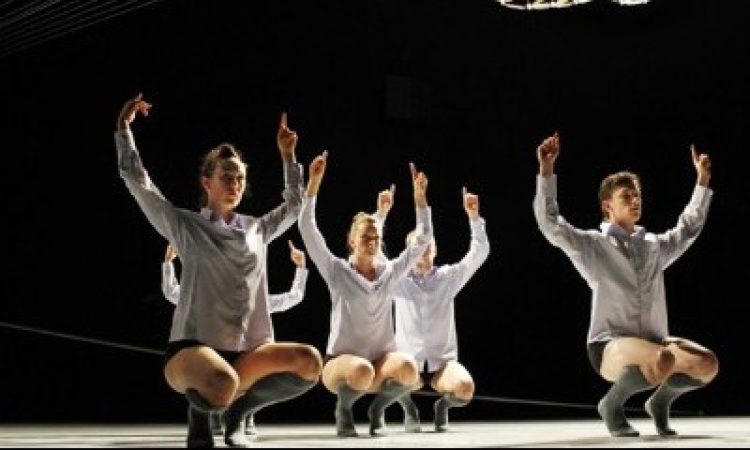
The departed performers return, wearing suits. They start to speak, one voice at a time in conversational tones, while moving in sharp geometric paths as their arms gesture like traffic cops signaling or temple priests’ weaving spells. One by one, they reveal their professional identity as museum guards—their pleasures, boredom, relationships, anxiety over an art theft. They strip off pants, skirts, and shoes, frolicking like children in socks and underwear, upon learning that the stolen art piece was returned, left at the museum’s back door and nearly disposed of in a dumpster: the janitor thought it trash, but the gallery director assured him it was important, costly, the work of a famous artist.
During this meditation on art and value, the dancers turn robotic, silhouetted downstage before they retreat to the sculpture, roll under it, and twitch in exquisite ecstasy as it slowly lowers over them. Blackout: we will not be privy to this interpenetration of art and life.
Nor need we be. The work has wrapped me in its web of mysterious beauty and I exit floating, like the mobile, in a billowing rhapsody.
Chunky Move, Dance Celebration series, Annenberg Center for the Performing Arts, November 17–19. No further performances.