The declarative title of Lionel Popkin’s There Is An Elephant in This Dance cued us to look for a pachyderm. But Aida it ain’t. The animal Popkin presents in his epic adventure is an idea, a brilliant deconstruction of elephant-ness, at once literal and figurative, earthly and spiritual, pertaining to both man and beast.
Popkin, whose mother was Indian, used the potent imagery of the elephant for his existential exploration of both identity and human nature. Ganesha, the Hindu elephant deity, was a god whose elephant head symbolized the highest existence of the soul and was joined to a rotund human body-form symbolizing the earthly life of humans. The entrancing dance created by Popkin included himself and superb co-performers, and original cast members Carolyn Hall and Ishmael Houston-Jones, joined by local guest artist Zornitsa Stoyanova. There Is An Elephant in This Dance, which I saw at its Danspace premiere in New York in 2009, traversed the breadth of human life from dreamy spiritual highs to grounded feral loping of animals and the finger sucking of a newborn.
In a signature, opening solo merging the duality of Ganesha, Popkin’s muscular agility allowed him, with his hands imprisoned in pockets and feet planted, to whip his head, neck and spine into swings and backbends. These extreme rotations and curves with expressive breaths implied a trip back in time to our animalistic roots while simultaneously creating the blurry, modernist image of a swiftly moving head in an expressionist portrait by Francis Bacon. Popkin mixed beauty and terror in the same virtuosic solo. At other times, we seemed to be witnessing evolutionary tensions between quadruped and biped moves alternating within the same body.
Hall assumed multiple roles as Popkin’s muse and foil, often appearing in striking dances with him, suggesting that they were two bodies moving as one in their synchronicity of timing and grace. She led Popkin around the stage with her finger in his mouth, either seducing him or tormenting him, and reigned serpent-like across his shoulders compelling him to accept her fingers in his mouth.
The mercurial Houston-Jones, like Hall, a Bessie award winner in New York, created compelling characters that ranged from a god-like Shiva posing on one leg or beating out rhythms with his feet, to an animal-like figure licking fingers or lumbering sideways on all fours, stalking the audience with a menacing, hulking shadow cast large on a side wall. Adding to the humor that permeated the work, Houston-Jones cast aspersions upon Stoyanova’s elephant “droppings,” pieces of her costume’s feet and hands that she quietly plopped onto the stage. Stoyanova, dancing in elephant costume, injected the creature with charm and endearment.
The fleeting, often deconstructed video images of elephants by Kyle Ruddick and Cari Ann Shim Sham ably supported the piece by giving distinct personae to the animal, including a critical stance toward the performance onstage. A wry and mischievous Popkin, in video and in person, created his own dances with his grey pachyderm costume wearing only some sections of it or aligning its head and trunk section aloft upon his own head.. The extraordinary music of Robert Een, whether in its airy vocalizations or playful, gallumphing rhythms, always seemed perfectly to match the visuals onstage.
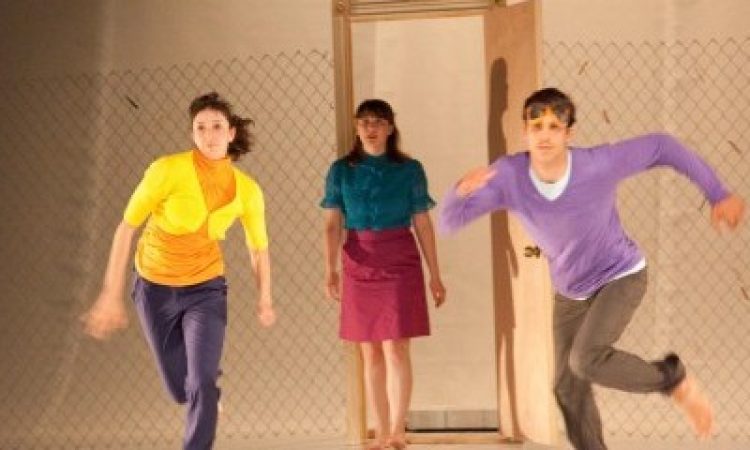
Gabrielle Revlock’s imperatively titled Share! addressed how communal mandates of “sharing experiences” among friends unwittingly subvert mutual warmth and acceptance, that are “sharing’s” intended goals. Revlock has an inventive arsenal of quirky, disquieting movement, articulated with arresting panache, that can both signal shared idiosyncrasies when executed in conjunction with fellow, equally eccentric dance partners, or can signal an individual obsessiveness that albeit often humorous, can be alienating. I observed the alienating aspects within this disconnected dance, which did not sufficiently advance the apparent intent of the work of showing the contradictions in the explosion of social media and peer generated “linkedness.”
The text, “I will share with you dominance, brutality and violence,” did not move me, nor did the action generated by the call of “attack” with Revlock and partner Greg Holt then rushing to the front of the stage only to halt abruptly to the words of, “stop, just kidding.” When Holt and Revlock, two excellent movers, did a kind of jerky, disjointed duet, they conveyed a dysfunctional sharing but little more. When, though, they worked in a trio with Bonnie Friel and stood before us in multicolored layered clothing, taking off and sharing underclothes, the piece worked better through use of smart, understated humor.
A question toward the end of the piece asked, “Is there anything else?” One could ask this of the work itself.
There Is An Elephant In This Dance by Lionel Popkin, and Share! by Gabrielle Revlock, presented by Philadelphia Dance Projects (PDP) at the Performance Garage, November 18 and 19. No further performances. philadanceprojects.org
(The writer is a member of the Board of PDP.)